 Fellow Canadians: All inFlow plans are available in Canadian dollars




Ask Americans what’s behind the product shortages of 2026 and only about one in five points to tariffs. In general terms, shoppers spread the blame across supply chains and manufacturing first, the measured read you’d expect from anyone following the news.
Ask those same shoppers about the specific empty shelf in front of them, the thing they came in to buy, and tariffs jump to the front. In a new inFlow survey of 1,000 U.S. adults who had all hit at least one stockout in the past 60 days, 73% called current U.S. trade and tariff policy a significant or primary cause of the shortages they personally run into, and 32% named it the single biggest cause.
That gap, between shortages in general and the one in your own cart, is the finding. Standing at the empty shelf, it feels like tariffs, whatever the broader data says, and that feeling is changing how people shop and who they trust.
Key findings
- Asked about shortages in general, only about 22% blame tariffs; asked about the shortage they personally hit, 73% call tariffs a significant or primary cause, and 32% call it the single biggest one.
- Among shoppers who’ve hit a stockout, 79% hit two or more in just 60 days.
- 81% are stockpiling or have considered it, with shoppers in the West (44% already stockpiling) running about double the Midwest (23%).
- 77% left a stockout trusting that seller’s inventory accuracy less than before.
- 23% have permanently switched sellers or suppliers after a stockout, and 21% have permanently switched brands.
- 71% would pay a premium to get the exact item right away, and 73% say they already have at some point because their preferred version was out.
- Asked what would have helped most, 25% wanted a recommended alternative, nearly double the 14% who wanted an accurate restock date.
Tariffs aren’t the whole story, but shoppers make them personal
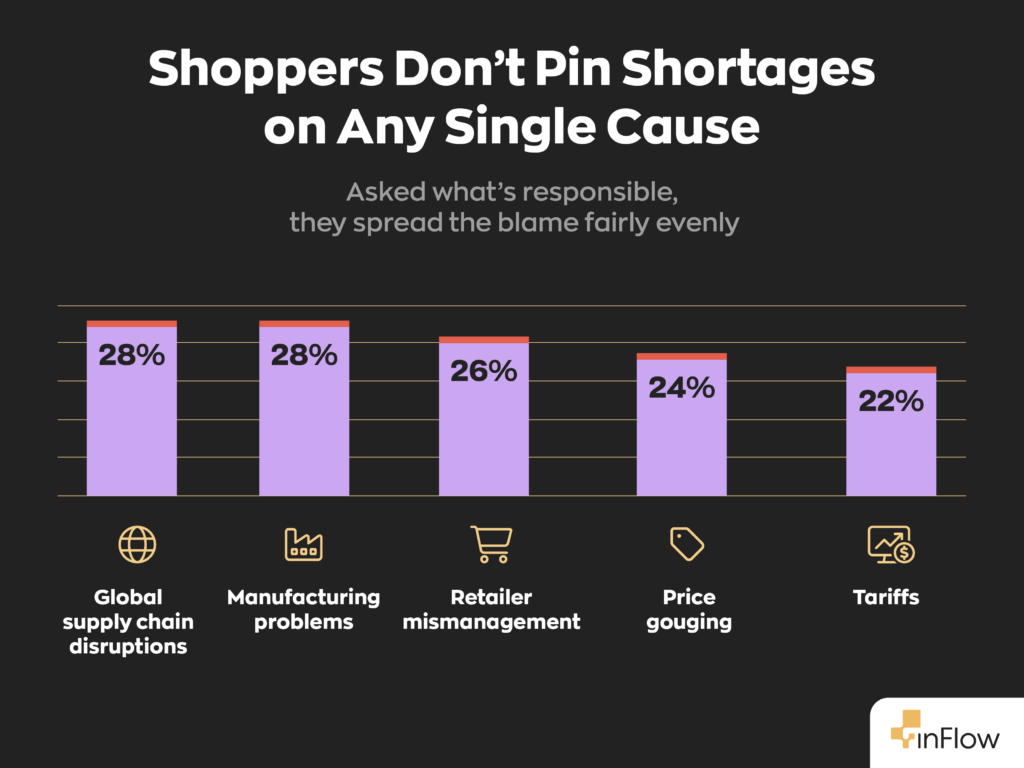
Shoppers don’t pin shortages on any single cause. Asked what’s responsible, they spread the blame fairly evenly:
- Global supply chain disruptions and manufacturing problems (around 28% each)
- Retailer mismanagement (26%)
- Price gouging (24%)
- Tariffs named by about 22%.
On paper, it’s a crowded field.
The picture shifts the moment the question gets personal. Asked in general terms, only about 22% named tariffs as a cause. Asked how much tariffs contribute to the shortages they personally run into, 73% called them a significant or primary factor, and 32% put tariffs at the very top.
The survey asked those two questions at different levels on purpose, one broad and one personal, and the gap between the answers is the point: tariffs loom much larger once the shortage is someone’s own.
Older shoppers felt it most, with 79% of adults 65 and up pointing to tariffs, compared with 65% of 18-to-24-year-olds. Tariffs have led the economic news for more than a year, which may be why they come to mind first when a shopper is staring at an empty shelf.
The U.S. average effective tariff rate reached 11.8% in April 2026 on a pre-substitution basis, the highest since the early 1940s, setting aside 2025’s steeper rates, according to the Budget Lab at Yale. And the pressure isn’t easing. A July 2026 paper from the Federal Reserve Bank of New York, drawing on its May regional business surveys, found that roughly 47% of service firms and 44% of manufacturers that had paid tariffs still planned to raise prices further, a sign that the cost increases shoppers already feel have further to climb.
Retailers see it too. The National Retail Federation’s Global Port Tracker projected a record volume of imported goods through major U.S. ports in July 2026, about 2.47 million twenty-foot equivalent units, as importers rushed to bring stock in ahead of possible August tariff hikes, then a sharp drop once the shelves were restocked. The supply side is bracing for the same thing shoppers are: more disruption ahead, with the added costs already showing up in prices.
Stockouts have become a routine part of shopping
Every shopper in this survey had run into at least one stockout in the previous two months, which is how they qualified to take part. So the frequency numbers describe people who’ve been through it, not the population at large. Even with that in mind, the numbers are striking.
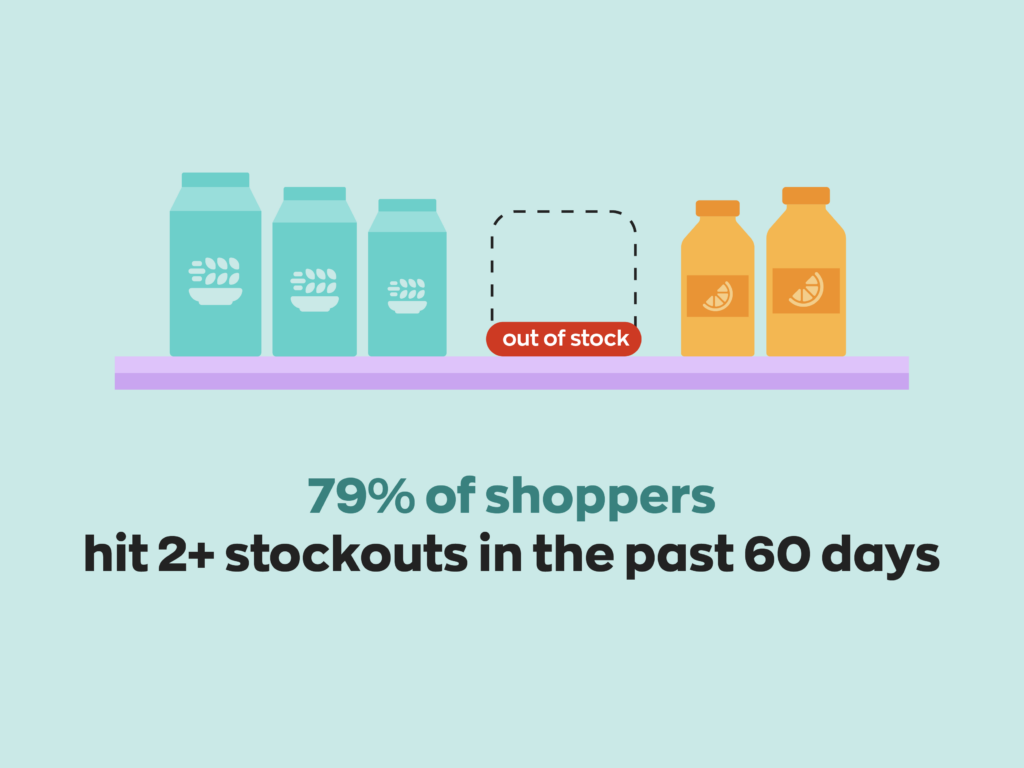
Nearly eight in ten (79%) hit two or more stockouts in 60 days, and close to one in five hit four or more. For most of these shoppers, an empty shelf has become a routine part of the trip
Perception is drifting the same direction. 40% feel items are out of stock more often than two years ago, against 38% who feel it’s less often. There’s a reassuring counterweight, though: 72% say availability is still better than it was at the peak of the COVID-era shortages.
Read together, the mood is one of low-grade fatigue. Shoppers aren’t alarmed, since most still see availability as better than the COVID years, but they’ve lost some faith that the shelf will have what they came for.
Shoppers are already changing how they buy
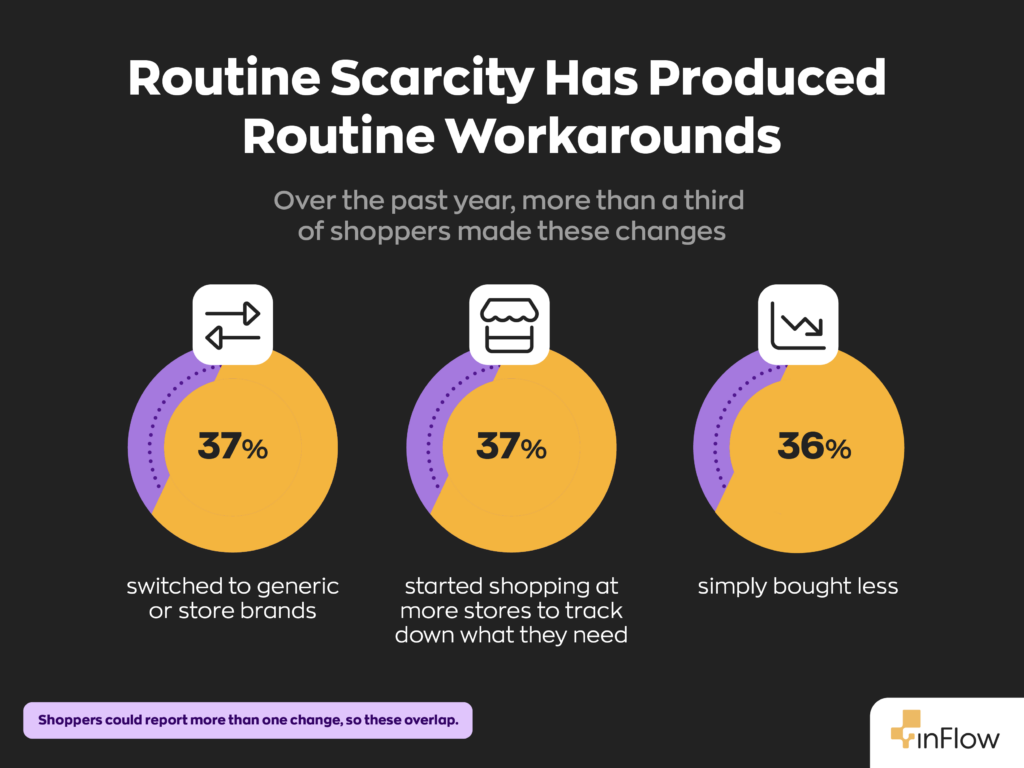
Routine scarcity has produced routine workarounds. Over the past year, more than a third of shoppers switched to generic or store brands (37%), and the same share started shopping at more stores to track down what they need. Another 36% simply bought less. (Shoppers could report more than one change, so these overlap.)
The clearest sign of a defensive mood is stockpiling: 31% are actively building up supply, and another 50% have thought about it, which puts about four in five somewhere on the stockpiling spectrum.
Where shoppers live shapes how far they take it. In the West, 44% are already stockpiling something, roughly double the 23% in the Midwest. Retailers are stocking up too. The National Retail Federation’s port data shows importers pulling shipments forward ahead of possible August tariff increases. The survey doesn’t pin down why households are doing the same, whether it’s tariff worry or leftover caution from the COVID shortages, but the impulse to keep a buffer on hand shows up on both sides of the counter.
The emotional cost of an empty shelf
A missing product sounds like a minor annoyance. Shoppers don’t rate it that way. The average frustration score for the most recent stockout was 6.8 out of 10, the median was 7, and 63% rated their experience a 7 or higher.
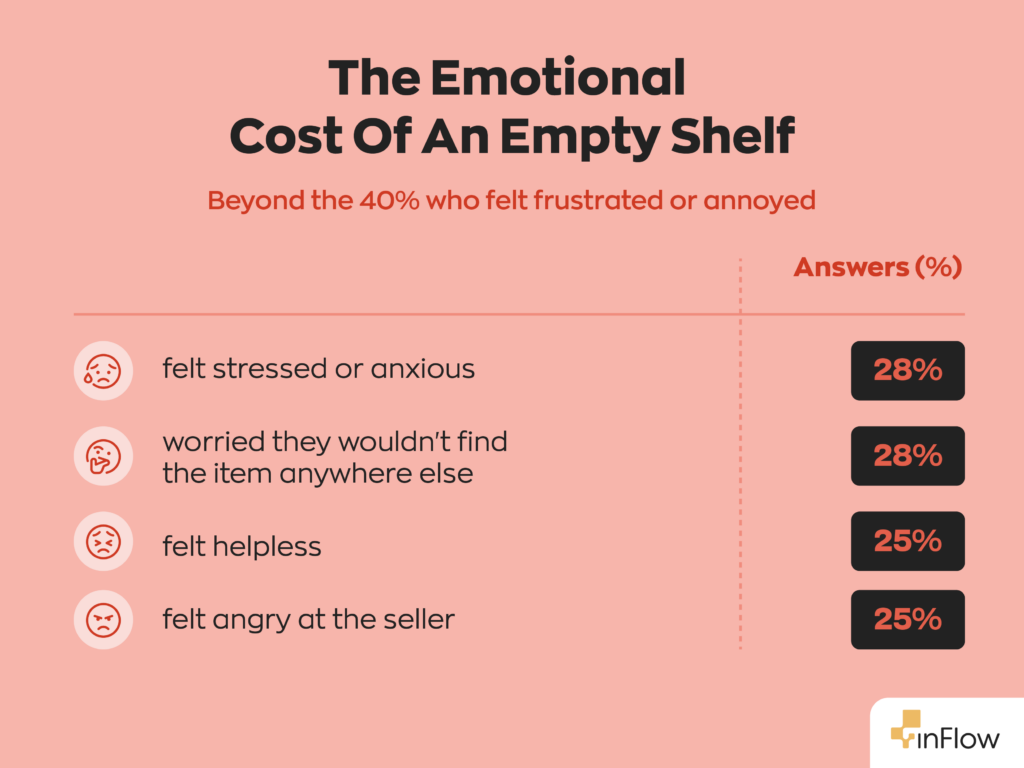
- 28% felt stressed or anxious
- 28% worried they wouldn’t find the item anywhere else
- 25% felt helpless
- 25% felt angry at the seller
Worry outweighed anger here, a milder reaction than the backlash a seller might expect, and for many the open question was simply where else they could find the thing. Nearly half of shoppers, 47%, said a stockout stresses them as much as or more than most of their everyday problems, which is a lot of weight to place on a product that isn’t there.
To put a single number on that experience, inFlow built the Stockout Stress Index, a 0-to-100 score drawn from three measures: the frustration rating shoppers gave their most recent stockout, how that stockout compared with their other daily stress, and the number of negative emotions it set off. It’s inFlow’s own construct rather than an official benchmark, but it travels well and it separates who’s hurting. The national score is 51, just above the midpoint of a scale where 0 is no stress and 100 is the most. The spread across groups is where the story sits:
| Group | Stockout Stress Index |
| Hit 4 or more stockouts | 58 |
| Bought for work (work use only) | 58 |
| Ages 35–54 | 55 |
| All respondents | 51 |
| Personal use only | 50 |
| Ages 18–34 | 48 |
| Hit 1 stockout | 44 |
Frequency is the clearest driver, a 14-point climb from the least to the most frequently burned. Business buyers land higher than personal shoppers, and shoppers aged 35 to 54 outscore both younger and older adults. The Index also moves by region:
| Region | Stockout Stress Index |
| West | 56 |
| Northeast | 52 |
| All respondents | 51 |
| Midwest | 49 |
| South | 49 |
Urban shoppers (54) report more stress than suburban (46) or rural ones (47), which runs against the assumption that having more stores nearby takes the sting out.
Trust erodes, even when the sale survives
A stockout damages trust even when the shopper eventually gets what they needed, and 82% did. 77% walked away trusting that seller’s inventory accuracy less than before, ranging from slightly reduced to, for a small share, destroyed outright.
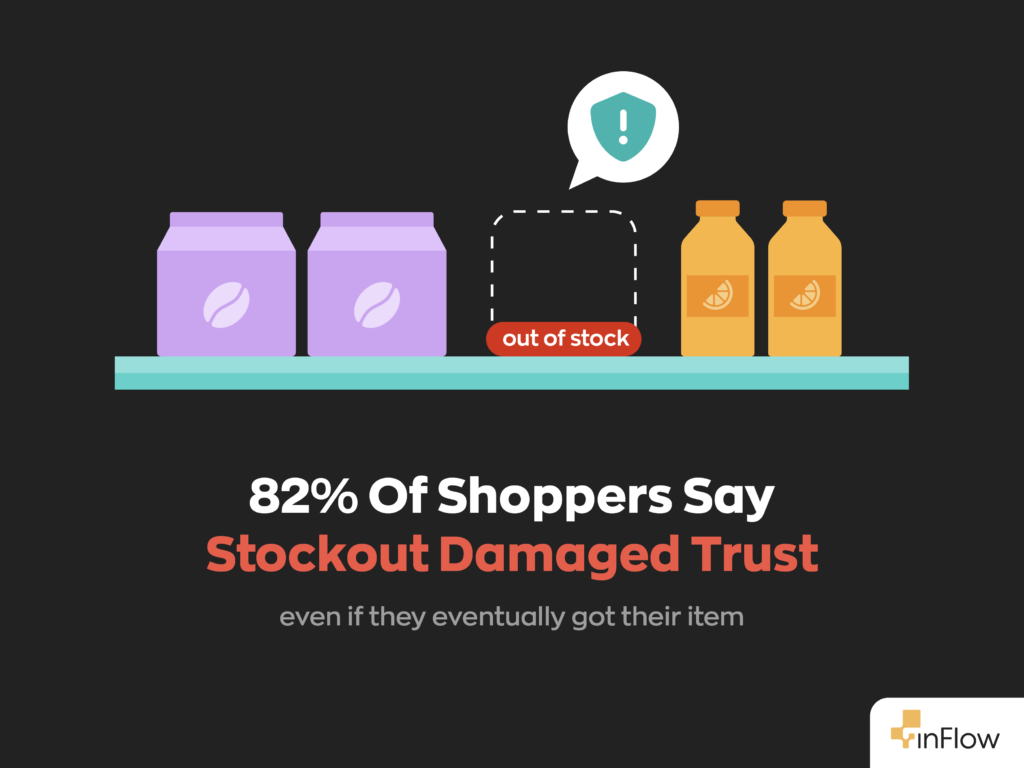
Only about 22% said the experience changed nothing. That distinction is worth holding onto. Shoppers can blame tariffs for the empty shelf and still fault the store for not knowing it was empty. The trust they lose is in the seller’s grip on its own stock, which is a separate thing from who they hold responsible for the shortage.
“Shoppers can blame tariffs for an empty shelf and still fault the store for not seeing it coming. Those are two different kinds of trust, and a retailer only controls one of them.” – Louis Leung, Co-founderof inFlow
And yet most of them come back. 58% said they’re just as likely or more likely to buy from that same seller again, and only 12% said less likely. Trust and loyalty appear to run on separate tracks. A shopper can feel let down by a seller’s shelf and still return next week, which may have as much to do with the hassle of switching as with any real forgiveness.
One group doesn’t come back. Roughly one in four shoppers has reached a limit: 23% have permanently switched sellers or suppliers after a stockout, and 21% have permanently walked away from a brand. Most people forgive an empty shelf. The ones who don’t tend to leave without a word, which makes them easy to miss until the numbers show up.
Put the findings side by side, and one stockout scatters in three directions. Shoppers point the blame at trade policy, but the costs land elsewhere. The retailer loses trust in its inventory accuracy (77%), and the brand can lose the customer outright, with 21% switching brands for good after a stockout. Three parties absorb a single empty shelf, and the one shoppers name as the cause is not the one that pays for it.
Shoppers will pay a premium, and many resent it
When the exact item is gone, most shoppers reach for a workaround before they reach for the door. 70% first look for a replacement from the same seller, most often a different brand, sometimes a similar item or a different size.
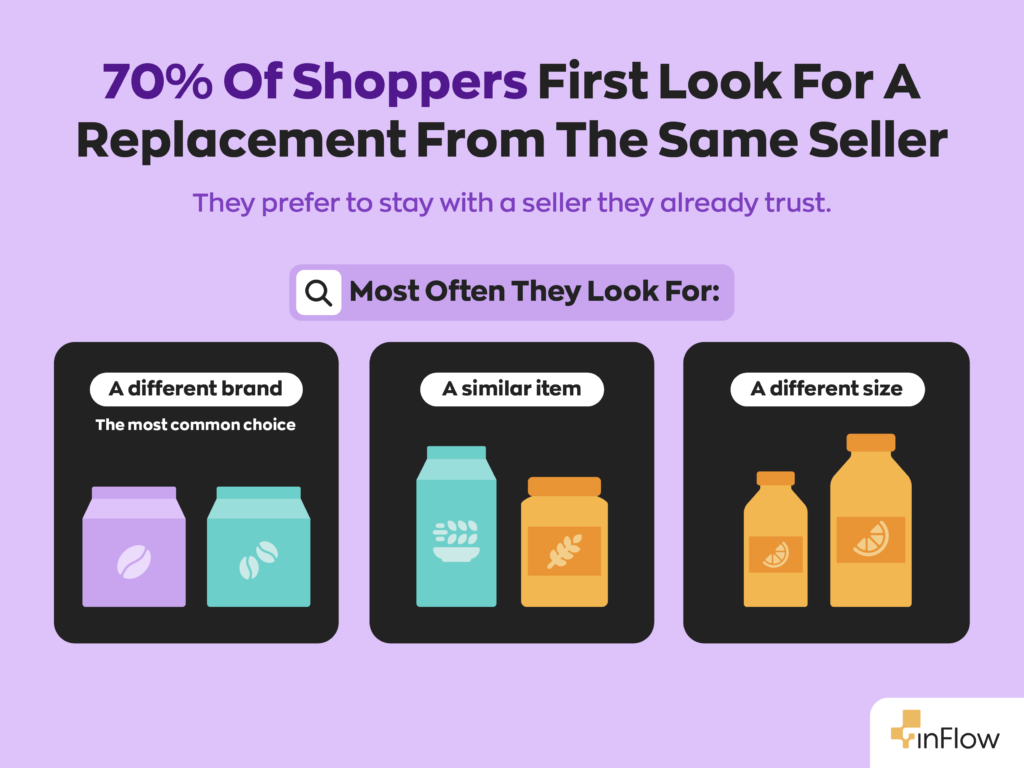
Only 22% immediately go elsewhere, and just 3% give up on the spot. The catch for sellers is where that substitution lands: among the 109 shoppers in this survey who ended up buying a substitute, 73% switched to a different brand. A stockout most often costs the manufacturer the sale while the retailer keeps it, though the retailer still pays in trust.
Money follows the same pattern. 71% would pay a premium to get the exact item right away, and this isn’t just talk: 73% say they’ve already paid more than planned because their preferred version was out of stock.
Paying up doesn’t mean liking it. About a third of all shoppers (32%) have paid more and resented it, and the split by gender was stark: 43% of men versus 23% of women. That’s one of the widest demographic gaps in the survey. The data doesn’t say why men objected nearly twice as often as women, only that they did.
The patience picture is calmer than the “shoppers want everything now” story would predict. Yes, 59% will wait two days or less, but only about 4% refuse to wait at all. Roughly four in ten will hold out three days or longer for the exact item before settling. Shoppers will wait, as long as they believe the item is really on its way.
Shoppers want a good alternative more than a restock date
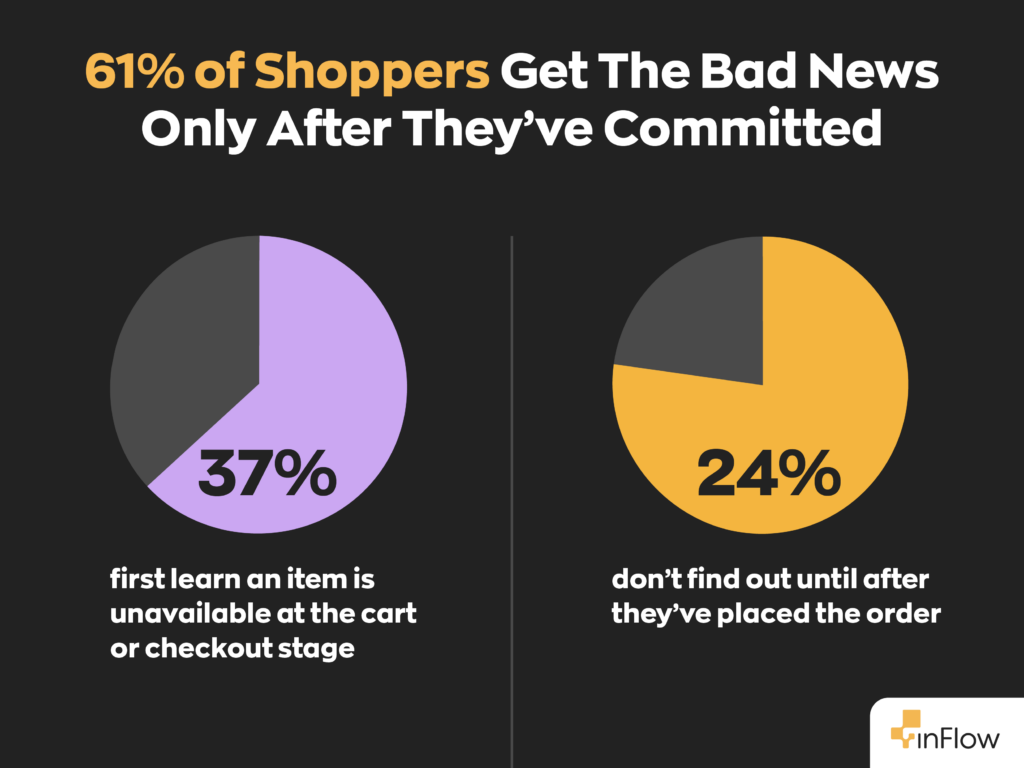
Most shoppers find out too late to do anything about it. 37% first learn an item is unavailable at the cart or checkout stage, and another 24% don’t find out until after they’ve placed the order, which means about 61% only find out once they’re already deep into the purchase, and a quarter not until after they’ve committed. On top of that, 9% got no information at all, no restock date and no explanation of any kind. That late notice is a likely source of the trust erosion above. The shortage itself may be beyond the seller’s control, but the silence around it is the part shoppers can hold against the store.
So retailers have poured effort into restock dates and back-in-stock alerts. Shoppers are asking for something else. When they were asked what single response would have helped most:
- 25% wanted a recommended alternative and
- 20% wanted reliable visibility into what’s actually in stock nearby
- 14% wanted an accurate restock date
- 12% wanted a back-in-stock alert
A useful alternative in the moment does more for shoppers than a promise about when the item comes back.
For all the attention paid to ecommerce fulfillment, the physical store is still where shoppers hit stockouts most often, cited by 36%, ahead of retailer websites (25%) and online marketplaces (22%).
The shelf remains the most common point of failure. That location matters for the fix shoppers asked for. A website can surface a substitute or a local-stock check on its own. A physical aisle usually can’t, which leaves the most common stockout setting the worst equipped to offer the very thing shoppers said would have helped.
What a stockout costs a business buyer
For 365 respondents in the survey, the stocked-out item was for work or business use, and their experience looks different from a consumer’s. The sharpest contrast comes from the 161 whose stockout was purely for work: they rated stockouts more frustrating (74% at 7 or higher, versus 62% for personal buyers) and were more than twice as likely to pay a 6%-plus premium (69% versus 31%).
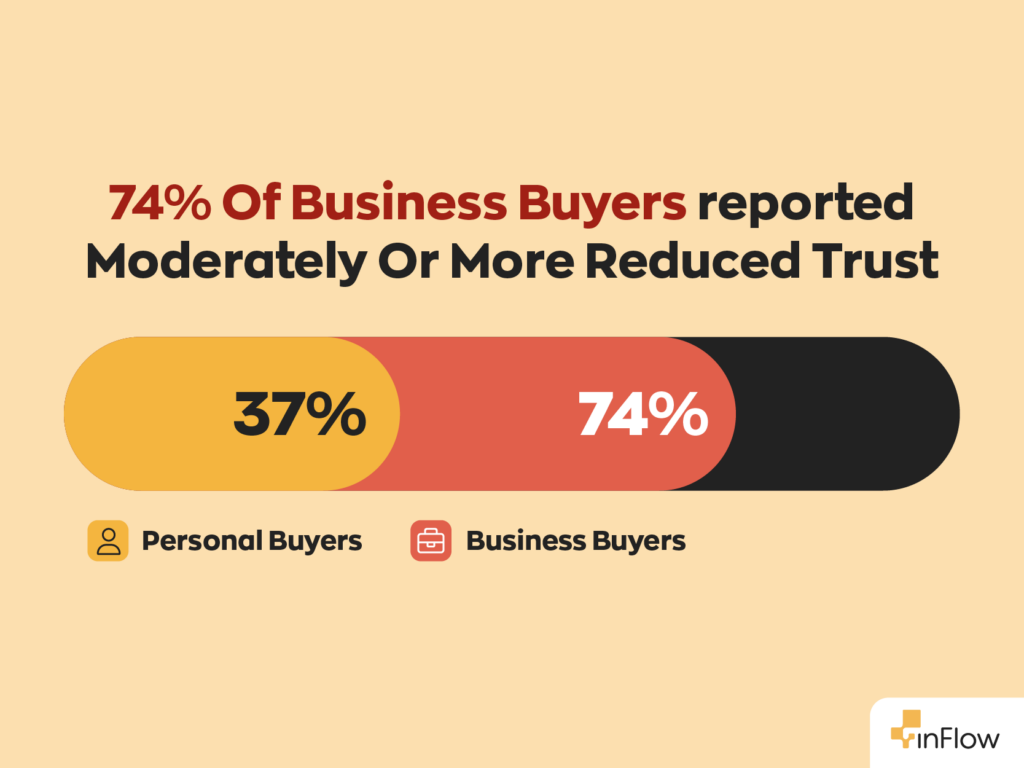
Their trust took a harder hit too: 74% of these work-only buyers reported moderately or more reduced trust in the seller, roughly double the 37% among personal buyers (That’s a stricter measure than the 77% overall figure above, which counts any drop in trust, however slight.)
What business buyers rarely do is leave. Only 9% of them walk to another seller as a first move, because for them the exact spec usually can’t be swapped. Across all 365 business buyers, 75% said the exact item or spec was required.
The cost surfaces downstream instead. Among all 365 business buyers, 45% needed a second trip or shipment. Another 41% saw production slow or stop, and 40% sent a technician who couldn’t finish the job on the first visit.
The difference from a consumer is mostly timing. A shopper’s stockout is over by the end of the day, while a business keeps paying for it. A separate study of inventory operators points to the same pressure from the supply side of the counter.
Summary
Strip away the numbers and what’s left is a familiar feeling. People used to assume the thing they wanted would be there, and increasingly they can’t. They’re adjusting the way people always do, by hedging. They keep a little backup at home and pay a bit more to skip the hunt, and they forgive a seller once or twice before moving on for good. It’s all fairly ordinary, the slow way people adjust when the shelf stops being something they can rely on.
The hopeful read is that shoppers aren’t asking for much. They’re not demanding instant delivery or endless selection. Mostly they want to know what’s actually available before they’ve invested their time, and to be pointed toward a real alternative when the first choice is gone. Honesty about the shelf, it turns out, buys more goodwill than any restock date. In a year defined by tariffs and uncertainty, that’s a small, oddly reassuring thing for sellers to hear.
Methodology
To understand how U.S. shoppers respond when the product they want is not on the shelf, inFlow surveyed 1,000 American adults in June 2026. Every respondent had experienced at least one stockout in the previous 60 days, so all findings describe people who have actually been through one rather than the general population. Participants answered questions about how often stockouts happen, what they blame, how they react in the moment, how long they’ll wait, how much they’ll pay, and how the experience affects their trust in sellers.
A subset of 365 respondents whose purchase was for work answered additional questions about business impact, and substitution detail reflects the 109 respondents who bought a replacement. Responses were analyzed by age, gender, Census region, household income, and area type (urban, suburban, and rural) to identify trends and differences. The survey was fielded by Audience Align (Study 260600) and balanced to U.S. Census targets on age, gender, region, and income. The Stockout Stress Index is an inFlow construct built for this study and is not an official industry benchmark. State-level figures reflect small samples and are best treated as color rather than precise rankings.
Fair use policy
Users are welcome to utilize the insights and findings from this study for noncommercial purposes, such as academic research, educational presentations, and personal reference. When referencing or citing this article, please ensure proper attribution to maintain the integrity of the research. Direct linking to this article is permissible, and access to the original source of information is encouraged.
For commercial use or publication purposes, including but not limited to media outlets, websites, and promotional materials, please contact the authors for permission and licensing details. We appreciate your respect for intellectual property rights and adherence to ethical citation practices. Thank you for your interest in our research.
FAQ
What do shoppers blame for empty shelves and product shortages?
Out of 1000 U.S. shoppers in this survey, they spread it around fairly evenly between supply chain disruptions and manufacturing problems at about 28% each, retailer mismanagement at 26%, price gouging at 24%, and tariffs trailing at 22%. But ask how much tariffs contribute to the shortages they personally run into, and 73% call them a significant or primary cause, with 32% naming them the single biggest one.
What do shoppers do when their go-to item is out of stock?
Most reach for a workaround before they reach for the door. 70% look for a replacement from the same seller; usually a different brand (32%), sometimes a similar item (21%) or a different size or spec (18%). Only 22% head straight to another store, and just 3% give up on the spot. The switching is where it costs someone: of the 109 respondents who bought a substitute, 73% chose a different brand, with 21% permanently switching brands after a stockout, while 23% have permanently switched sellers.
Are shoppers stockpiling because of shortages?
More than you’d expect. 31% say they’re actively stockpiling or buying in bulk right now, 26% across multiple product categories, and another 50% have considered it without pulling the trigger yet. That puts roughly four in five somewhere on the stockpiling spectrum.
How long will shoppers wait for an out-of-stock item?
Not long, but longer than the “everyone wants it now” story suggests. 59% will wait two days or less, with 42% naming a one-to-two-day window. Only 4% won’t wait at all, and 41% will hold out three days or more for the exact item.
Does a stockout hurt trust in a retailer?
Yes, and quickly. Even though 82% eventually got what they needed, 77% trusted that seller’s inventory accuracy less afterward. The twist is that most come back anyway. 58% said they’re actually more likely to buy from that seller again. Trust and loyalty run on separate tracks, so a damaged relationship isn’t necessarily a lost customer, at least not right away.
What can retailers do when they can’t prevent a stockout?
Be upfront, and offer something better than a vague promise. Asked what single response would have helped most, 25% wanted a recommended alternative and 20% wanted reliable visibility into nearby stock, both ahead of the 14% who wanted an accurate restock date.
0 Comments