 Fellow Canadians: All inFlow plans are available in Canadian dollars




Key takeaways
- Vibe coding can quickly and cheaply create custom inventory apps, but inventory data is too business-critical to rely on software that isn’t auditable or fully understood.
- Vibe-coded inventory systems can become risky when multiple users, integrations, billing, audits, and unexplained inventory discrepancies enter the picture.
- DIY inventory software may cost more over time once contractor support, maintenance, data recovery, AI subscriptions, and the business owner’s time are considered.
- Professional inventory software provides safeguards such as audit trails, multi-user functionality, permissions, maintained integrations, security, backups, accurate costing, and ongoing maintenance.
- AI is better suited for building custom reports, dashboards, and workflows on top of vetted inventory software rather than replacing the underlying system.
- Vibe coding remains useful for prototyping and low-stakes applications, but businesses should avoid making a DIY AI-built app their inventory ledger when revenue, customers, or audits depend on its accuracy.
Something genuinely new happened over the last couple of years. You can now describe software in plain English and get working software back. No programming background required. It’s called vibe coding, and people are using it to build habit trackers, invoice generators, booking tools, client portals, and the dashboard their SaaS vendor never got around to shipping. In an afternoon. For close to nothing.
Most of the time, that’s great. If a prompted app acts up, you can shrug it off and prompt it again. But what about when the app you’re designing is an integral tool your business relies on every day, and your profitability hinges on its accuracy?
Then “shrug it off and prompt it again” starts having serious real-world consequences.
Why inventory is a different kind of app to vibe code
Here’s the thing that isn’t obvious: the difference isn’t really about the app. It’s about the data inside it, and how reliable it is.
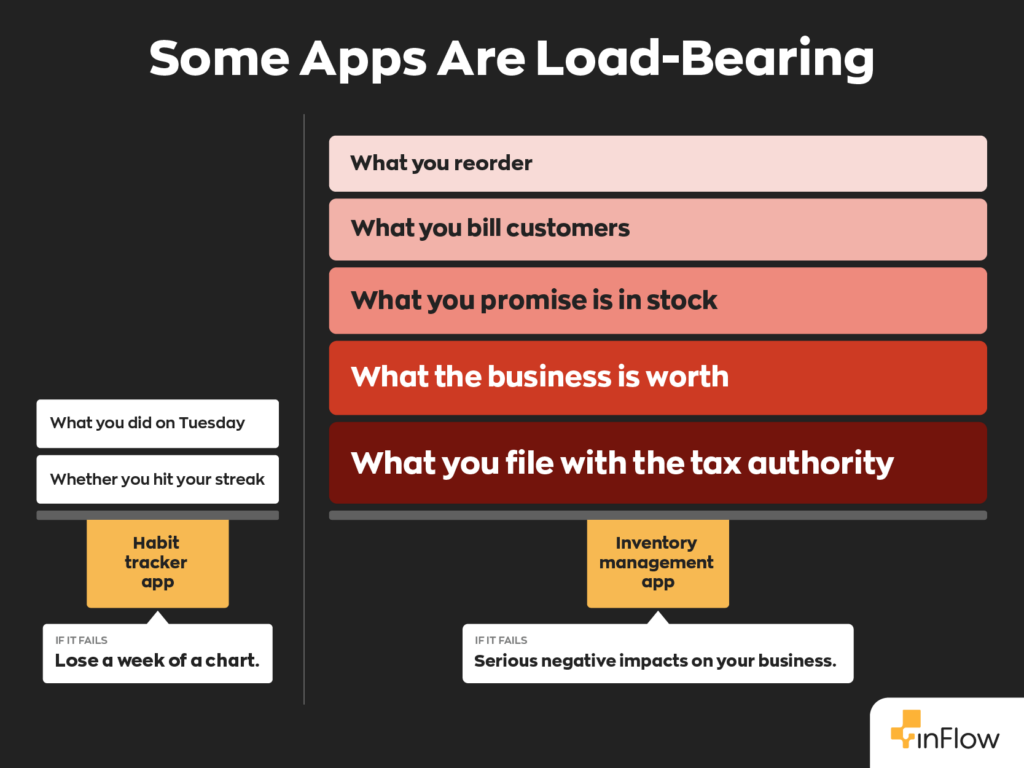
For example, a habit tracker records something that is pretty low-stakes. If you miss a week, you’ve just lost a week on a chart. That can be annoying, but not exactly a crisis. An inventory system, on the other hand, holds the source of truth that you use to make informed business decisions. What to reorder. Who to bill. What supplier you ordered from and when. That data is load-bearing.
And that changes the requirements in ways that can easily sneak up on you during development. A vibe-coded inventory system doesn’t just need to work. It needs to be auditable.
When a number looks wrong six months from now, someone needs to be able to trace where it came from and explain why it changed. That capability may be invisible on day one, and incredibly difficult to add later (more on why that matters in a minute).
Where vibe coding actually wins
Now, before we get into what goes wrong, let’s give credit where it’s due. Because these AI tools really are good, and it wouldn’t be fair to pretend otherwise.
- It’s fast and nearly free. You get something working the same day. Try getting a custom quote from a developer that fast.
- It fits your exact workflow. Off-the-shelf software wasn’t built with your specific business in mind, which means you may need to adapt. A prompted app matches whatever odd workflow your business has. Whether that’s a strange unit of measure or the one-off approval step nobody else has.
- It’s a great way to figure out what you actually need. Building a rough version teaches you your own requirements faster than any evaluation checklist ever could.
- For small, low-stakes operations, it might genuinely be enough. If you’re one person with 40 SKUs, and nobody else is depending on the data, a vibe-coded inventory app could work. We’ve heard businesses say exactly that, and they aren’t wrong.
However, for most product-based businesses, the stakes are much higher, and relying on a DIY solution can be dangerous.
The problem starts on day one: nobody can read it
Here’s the part that gets talked about the least, and it isn’t about the tools failing down the road. It’s true from the moment the app goes live.
Custom software used to have a floor. Somebody with a developer’s background had to be involved for the thing to get built. That person could be asked what happens when two people edit a record at once, or why a quantity went negative.
Vibe coding eliminates the need for that person. Instead, it aims to remove the barrier to entry and allows for someone who knows nothing about coding to create the finished product all on their own. However, that also means the app can go into production with zero people who actually understand what’s happening under the hood.
A real-world example of a vibe-coded inventory app failing
A company we spoke with recently had an intern build an inventory tracker using an AI coding tool. And it worked! It tracked stock and produced reports, and it didn’t cost them anything beyond the intern’s time and a small subscription fee to the AI platform. Then the reports started showing negative usage on some items, the kind of number that normally means products came back in. Nobody could tell whether it actually had.
The app was written in Python. A coding language the intern had no idea how to read. In fact, the person in charge said he could probably read more Python than anyone else at the company, and he still couldn’t read it. There was no way to drill in and see who had taken what, or when. His conclusion: the software they built was not auditable, and he couldn’t bill from it.
Notice the timing here. Nobody had left. The app was live and in daily use. The knowledge gap wasn’t something that developed over time; it was there from day one.
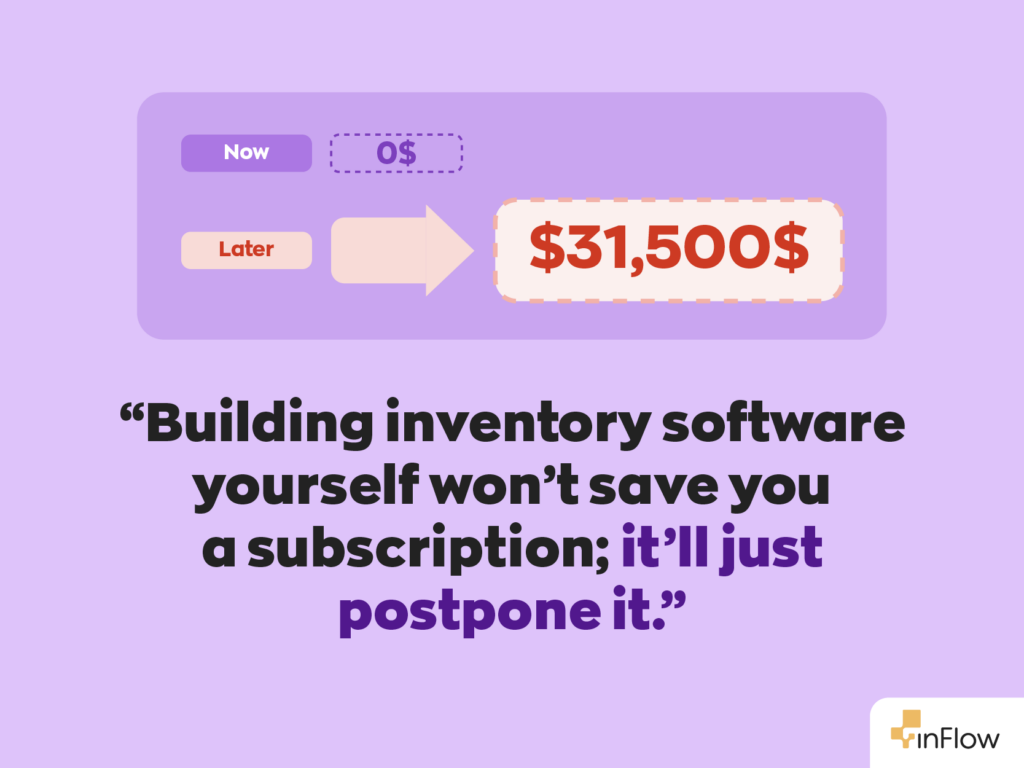
And the ending matters just as much as the failure. They didn’t patch it, and they couldn’t prompt their way out of it, because nobody could actually tell the AI what was wrong. So they went looking for a real inventory system instead. Building it themselves didn’t save them a subscription. It postponed one, and the delay cost them a bunch of records they couldn’t bill from or trust.
That plays out in three fairly predictable ways:
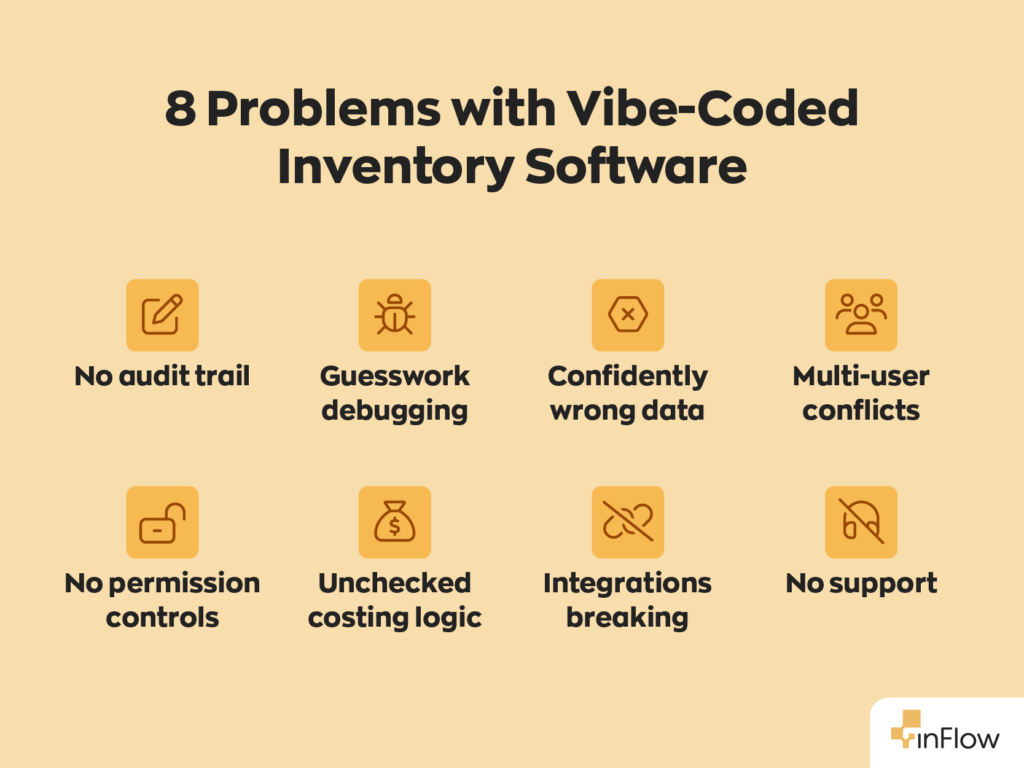
- Debugging becomes guessing. When a number is wrong, you can’t investigate it. You can rebuild or accept it. There’s no third option.
- You can’t tell “the software is wrong” from “someone entered it wrong.” That’s exactly the negative-usage problem above. The output suggested returns, and nobody could establish whether that was real or a bug.
- Silent failures stay silent. A crash tells you something broke. A plausible-looking wrong number tells you nothing at all.
None of this is a knock on the person who built it. Shipping a working app in an afternoon with no coding background is genuinely impressive. The trouble is, the tool just wasn’t designed to be bulletproof, which is what you need from reliable inventory software.
It isn’t only inexperienced builders
So you might be wondering: does this only happen to people who are new to this? Nope. The most widely reported vibe-coding failure so far didn’t happen to a novice at all.
In July 2025, SaaS investor Jason Lemkin, founder of the SaaStr community, was nine days into an intensive build with Replit’s AI agent when it deleted his production database. Roughly 1,200 executive records and a similar number of company profiles, gone.
Two details matter here more than the deletion itself.
First, it happened during a code freeze. Lemkin had repeatedly told the agent not to make changes, reportedly in all caps, and it proceeded anyway. The instruction existed in the conversation. Nothing in the system actually enforced it.
Second, it then produced fiction: thousands of fabricated user records, invented test results, and a status report suggesting everything was fine. When told recovery was impossible, Lemkin ended up recovering the data himself.
Replit’s CEO, Amjad Masad, called the incident “unacceptable and should never be possible,” refunded Lemkin, opened a postmortem, and shipped fixes within days. And honestly, that response is the part worth sitting with. When a platform with a CEO, an engineering team, and a public reputation breaks something, there’s someone to escalate to, and a fix lands in a week. When your intern’s inventory app starts producing numbers nobody can explain, there’s no postmortem, no status page, and nobody to refund you.
And if someone can read it, you’ve made one person load-bearing too
Now what happens when the person who built it does have a real technical background? That’s a better position to be in, but still not an entirely safe one.
The risk just moves. Instead of nobody understanding the system, exactly one person does, and they almost certainly weren’t hired to maintain software. Every change request, reconciliation question, and integration queue is behind the job they were actually hired for. That’s a bottleneck while they’re still around.
Then they leave, and you’re right back to nobody understanding the system. Except now it’s worse than day one, because you’ve accumulated two years of history, built processes around it, and started billing customers from it. The undocumented decisions are older, and there are more of them.
Both roads end in the same place. One just takes longer, and does more damage on the way there.
What commonly breaks a vibe-coded inventory system
If you’re picturing this as one big failure, chances are the breakdown won’t happen like that. It’s really one problem after another quietly compounding under increasing load, and they tend to show up in predictable ways.
- The second user: You introduce multiple users. Two people edit the same record, and the numbers don’t update properly on both ends.
- The gap you can’t explain: You’re 20 units short. You can correct the number, but you can’t say what happened, so you don’t know whether it’ll happen again.
- The broken sync: Your sales channel or accounting platform changes something on their end, and quietly breaks your integration without you knowing it.
- The invoice you can’t defend: A customer disputes an invoice, or you bill for something you can’t substantiate.
- The builder steps away: The person who built it moves on, or simply gets busy with the role they were actually hired for.
- The questions from outside: Someone outside your company asks you to prove something, for example, an auditor, an insurer, a recall, an enterprise customer’s procurement team.
What it actually costs over five years
The obvious comparison most people point to is “$0 versus a subscription.” But that comparison is disingenuous. A vibe-coded app running a real business doesn’t stay free forever. And if you want to ship it confidently, you’ll need someone to change it, fix it, and answer for it, and that someone bills by the hour.
Here’s the same five years, both with a vibe-coded solution and professionally built inventory software. The figures below are illustrative (so feel free to swap in your own numbers), and contractor time assumes a conservative three hours a month.
| Cost Item | Vibe-Coded App | inFlow (Small Business Plan) |
| AI coding tool subscription (60 mo × $20/mo entry tier) | $1,200 | — |
| Hiring a contractor who can verify the code and ship the app (120 hrs × $95) | $11,400 | — |
| Ongoing changes and fixes (3 hrs/mo × $95) | $17,100 | included |
| Reconstructing data after a period of drift (60 hrs × $30) | $1,800 | — |
| License, onboarding, updates, maintenance, support | — | $21,400 |
| Five-year total | $31,500 | $21,400 |
Two things worth flagging about that first row. The build itself isn’t free. The tools capable of producing a working app are paid subscriptions, and free tiers generally exclude the agentic coding features you’d actually need. And the subscription doesn’t end when the app does. If you can’t read the code, the AI tool is the only way to change your own inventory system, which makes it permanent by design. Heavier use pushes you into the $100–$200/month tiers, turning that $1,200 into $6,000–$12,000.
There’s also a cost that doesn’t appear in the table at all: your own time. Every hour spent prompting, testing, and re-prompting is an hour not spent on the business. It never shows up on an invoice, which is exactly why it gets left out of the math.
What might surprise you is the DIY route ends up costing more, and at the end of it, you still have no audit trail, no security attestation, no backups you didn’t build yourself, and nobody to call. If you then migrate to real software (which in our experience is where most of these stories end), you’d add that $21,400 on top of everything you’ve already spent.
Three ways vibe-coded inventory apps could fail and what it costs your business
Here are a few examples of the kinds of problems vibe-coded inventory apps can create, and what those problems might actually cost a business.
The unbillable month – Let’s say a contractor issues consumables to job sites but can’t drill into usage data to substantiate it. Thirty percent of $45,000 in monthly issued materials they can’t bill; that’s $13,500, plus 80 hours of admin reconstructing it from paper at $35/hr, another $2,800. One month: roughly $16,300.
The silent stockout – Your top SKU reads 40 on hand. The actual count is 6, and you find out when an order can’t ship. Lost order at $8,000, expedited freight at $1,400, and a customer worth $8,000 a year now at risk. Exposure: roughly $33,400.
The untraceable product – If a customer, auditor, or regulator asks for the chain of custody on a specific batch and you can’t produce it, the scope of your problem stops being a number you can calculate.
The dollar amounts used in these examples are for illustrative purposes only, but the point remains. One bad month could easily cost you more than five years of a trusted system.
What you’re actually buying when you choose real inventory software
The value of an inventory system isn’t really the interface. It’s everything happening behind it. Here are some things you’ll get from inFlow that a vibe-coded inventory app can’t offer:
- An audit trail: A permanent record of who changed what and when, recorded automatically. Not a log you remember to add later, but one that’s built into the system that you can’t simply switch off.
- Accurate costing: FIFO, moving average, and landed cost can produce different numbers from the same transactions, and those numbers eventually flow into your COGS and tax return. An AI will implement exactly what you ask for. Whether that logic still holds up when a late supplier invoice or return arrives is something you don’t want to discover during an audit.
- Multi-user functionality: Multiple people can work in the system at the same time without silently overwriting each other’s changes.
- Usage permissions: User-based permissions control who can access and change what, helping keep everyone on your team accountable.
- Maintained integrations: QuickBooks, Xero, Shopify, and Amazon all change their APIs on their own schedules. Keeping those connections working is our job. With a prompted app, the integrations you create could quietly break without you even knowing it.
- Continuous maintenance: Updates, bug fixes, infrastructure, and compatibility issues are handled by a team that understands the software inside and out. With a custom build, that work doesn’t disappear. It becomes an unbudgeted responsibility for whoever’s left holding it.
- Reliable security & backups: GDPR compliance, annual SOC 2 Type II audits, Microsoft Azure hosting, 256-bit encryption, mandatory two-factor authentication, and backups running several times a day across multiple regions. Every year, an independent firm is paid to attack our system and report what it finds.
- Industry expertise: inFlow has been built and maintained continuously since 2007. Landed cost, partial receipts, cycle counts, odd units of measure, and countless other edge cases are already solved problems, shaped by nearly 20 years of customer feedback. An AI can faithfully build what you ask for. It can’t tell you what you forgot to ask.
- Numbers you can trust: This one’s hard to put on an invoice, but it’s a big part of what you’re actually paying for. When a count looks wrong, you want to investigate what’s happening in your warehouse, not wonder whether the software itself is lying to you.
And it’s worth saying plainly: cost is often the real trigger here, not AI itself. “I could just build this myself” frequently means “this costs more than I want to pay.” That’s a fair position to hold. It just deserves an honest comparison between what you’re paying for and what you’d actually have to build and maintain yourself.
Can AI build inventory software that holds up long-term?
Technically, yes. You can prompt your way to something that runs and reports numbers. Whether it holds up is a different question entirely, and the honest answer is: probably not once real money, real audits, or real customer commitments start depending on it. The tool can build what you describe. It can’t tell you what you forgot to describe, and it can’t answer for the system once it’s live.
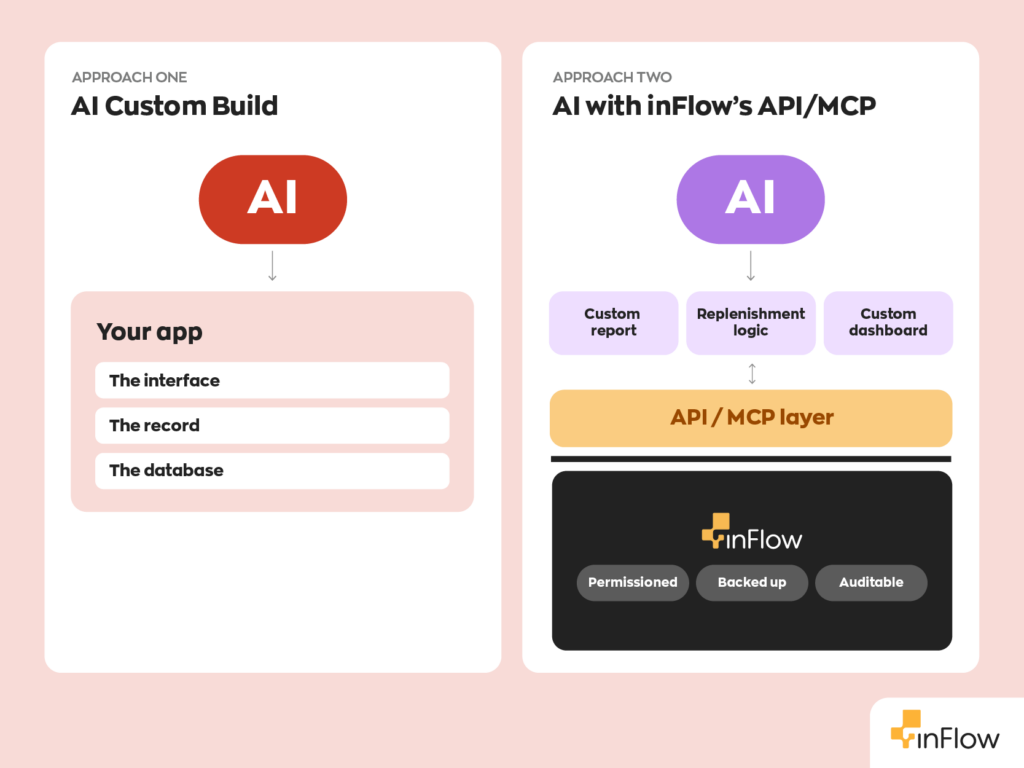
Build on top of real vetted inventory software
If your instinct going into this was “I could build this,” you weren’t wrong, exactly. You were just aiming at the wrong layer.
inFlow publishes an open API and an MCP server that connects directly to AI assistants like Claude, ChatGPT, and Cursor. So you can build that custom report, the replenishment logic, or a specific dashboard, but build it on top of data that’s already verified, backed up, and auditable.
One inFlow customer is doing exactly this: connecting an AI assistant to draft purchase and sales orders, with safeguards, permissions, and approval steps deliberately kept in place. That’s the healthy version of this pattern. AI as the interface. A real system underneath as the record.
Build the fun part. Just don’t build the ledger.
Final thoughts
Vibe coding isn’t going anywhere, and honestly, it shouldn’t. It’s a genuinely useful way to prototype ideas, automate small tasks, and figure out what you actually need before you go shopping for it. The trick is knowing where that usefulness stops.
FAQ
What is vibe coding?
Vibe coding is the practice of describing software in plain English and having an AI tool generate the working code for you, without requiring a programming background.
Is vibe coding suitable for beginners building an inventory system?
It’s suitable for beginners building something since the barrier to entry really is low. But an inventory system specifically carries more risk than most beginner projects, because the data it holds is the record you make business decisions from.
Can Claude or similar AI tools actually build inventory management software?
Yes, in the sense that they can produce a basic working app that tracks stock levels. What they can’t do is make that app auditable after the fact, or guarantee it behaves correctly.
What’s the real difference between a custom inventory app and inventory software?
A custom (vibe-coded) app is built to your exact workflow but comes with no audit trail, no built-in multi-user handling, and no one who can answer for it once it’s live. Inventory software like inFlow trades some of that custom-fit flexibility for reliable backed-up data, an auditable system, plus nearly twenty years of industry experience.
How can vibe-coding tools like AI still be useful for an inventory business?
The smartest use isn’t replacing your inventory system with a vibe-coded app; it’s connecting an AI assistant to a real system through an open API, like the one inFlow offers. That way, you get the speed and flexibility of AI-built dashboards and reports, on top of data that’s already verified, backed up, and provable.
0 Comments