 Fellow Canadians: All inFlow plans are available in Canadian dollars





Key takeaways
- GS1 Sunrise 2027 is a global initiative to ensure POS systems can scan both 1D and GS1-compliant 2D barcodes.
- Traditional 1D barcodes only store a GTIN, while 2D barcodes can hold detailed data like expiration dates, batch numbers, serial numbers, and URL/digital links.
- GS1 Digital Link enables 2D barcodes to function like web links, connecting physical products to online information.
- Businesses are already in a coexistence period in which 1D and 2D barcodes coexist on labels.
- Preparing for Sunrise 2027 involves assessing current systems, upgrading hardware/software, and updating labeling processes.
For years, GS1 has been preparing the industry for a major shift with its Sunrise 2027 initiative. The global non-profit has been quietly advancing this initiative, reshaping how businesses handle product identification, inventory tracking, and point-of-sale (POS) operations.
Now, as we move into the second half of 2026, that deadline is starting to feel very real. And the truth is, Sunrise 2027 won’t just impact a handful of large enterprises. It’s going to affect any business that scans barcodes, from small retailers to large manufacturers, and everyone in between.

The good news? This isn’t a hard deadline that’ll shut down your business overnight. It’s more like a gradual sunrise (yes, pun intended) that’s already begun, giving businesses time to adapt. The challenging part is cutting through all the technical jargon to understand what this actually means for your day-to-day.
So if you want a breakdown of the GS1 Sunrise 2027 initiative in plain English, you’ve come to the right place. We’re going to explore what it means for different types of businesses, and give you a clear roadmap for what to do next.
What is GS1 Sunrise 2027?
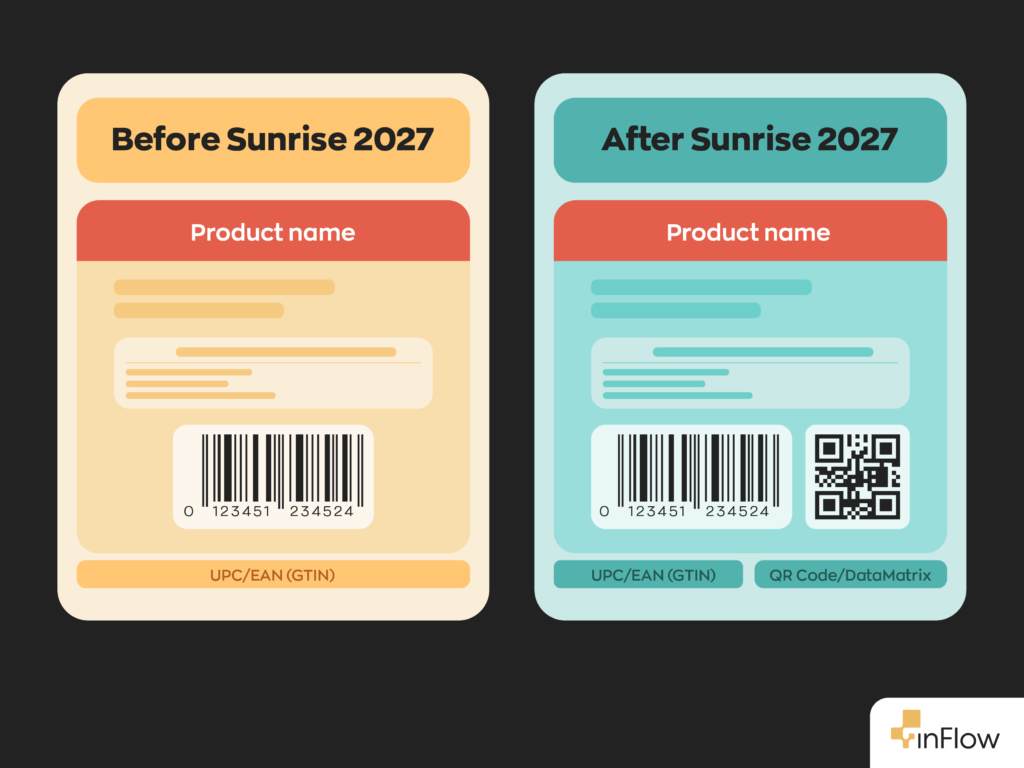
GS1 Sunrise 2027 is an industry-led milestone with an initial goal to ensure that retail POS scanners and their supporting software can read and process GS1-compliant 2D barcodes alongside existing 1D barcodes by the end of 2027. At a minimum, retailers need to be able to pull the GTIN from a 2D barcode for price lookup, even if they’re not using all the extra data yet.
Currently, when you scan a traditional 1D barcode (UPC/EAN), you get basic product identification. Essentially, this is just a number that tells the system “this is Product X.”
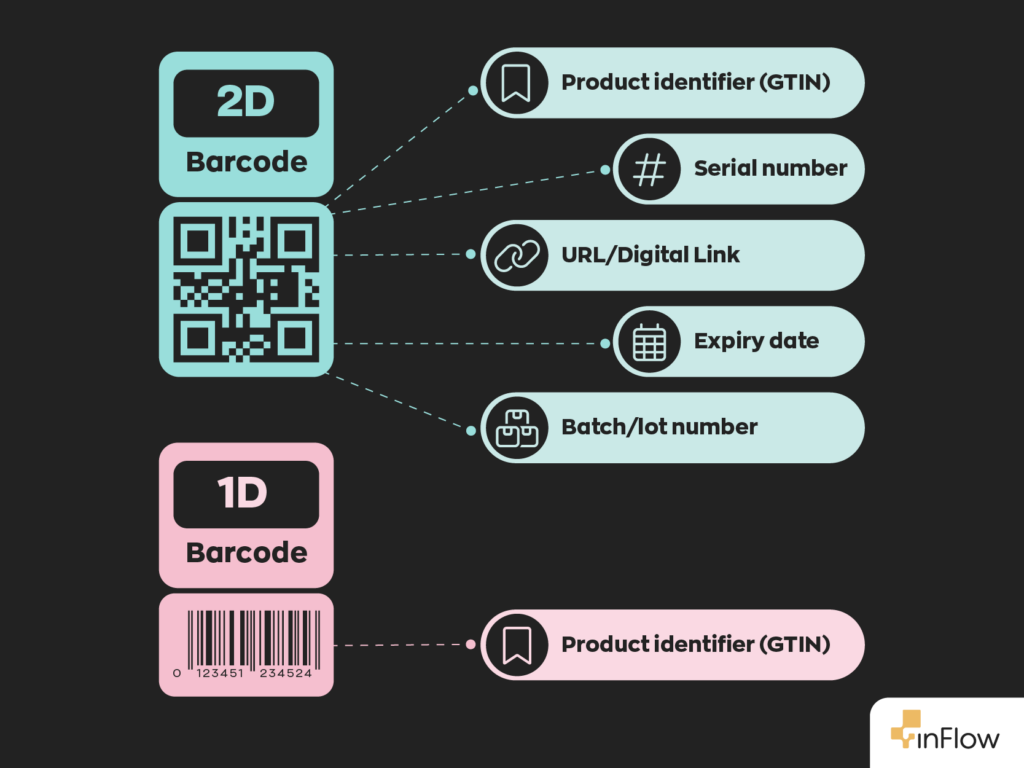
By comparison, with 2D barcodes, far more information can be embedded directly in the code itself, such as, expiration dates, batch and lot numbers, serial numbers, manufacturing locations, and links to digital product information.
This shift turns barcodes into comprehensive data carriers, rather than simple reference numbers.
The technology behind the transition
Now that we’ve covered the core idea of Sunrise 2027, let’s take a closer look at what’s actually changing under the hood. Because this shift isn’t just about shiny new 2D barcodes, it really boils down to what these barcodes can do that 1D barcodes can’t.
Understanding 1D vs 2D barcodes
Traditional 1D barcodes appear as a series of lines of varying width and spacing. Barcode scanners can read these patterns and decipher them as an alphanumeric code. In other words, they translate visual patterns into usable data.
For example, the most common 1D barcodes retailers use are EAN and UPC, and are primarily for product identification. These barcodes are fixed-length numeric identifiers known as GTINs (for example, UPC‑A is 12 digits; EAN‑13 is 13 digits). Since EAN and UPC barcodes can only carry a GTIN, the information is very limited.
2D barcodes, on the other hand, store information both horizontally and vertically, allowing them to hold thousands of characters. The aim is to transition to GS1-compliant 2D barcodes, such as QR Codes with GS1 Digital Link URI syntax (“QR Codes powered by GS1”) and GS1 DataMatrix.
This expanded capacity enables what GS1 calls “data-rich” barcodes. Instead of just identifying a product, these codes can tell you:
- When it expires
- Which lot or batch it came from
- Where it was manufactured
- Recall information
- Sustainability credentials
- Digital product manuals or certifications
So, while this shift may come with a few growing pains, the added value that 2D barcodes bring makes it well worth the upgrade.
GS1 digital link technology
The key standard for “QR Codes powered by GS1,” is the GS1 Digital Link, because it turns product identifiers and all additional information into a web-friendly URL format. In other words, it lets a barcode act like a direct link to online information.
However, it’s not the only 2D format included in the Sunrise 2027 initiative. GS1’s 2D barcode framework also includes GS1 DataMatrix, which uses a different structure (element string syntax) but serves a similar purpose.
So, what does this actually mean in practice? When scanned, these barcodes can take users straight to detailed product pages, certifications, or instructions, effectively bridging the gap between physical products and digital experiences.
For businesses, this means you can use a single barcode for tracking inventory tracking, point-of-sale transactions, consumer engagement, and regulatory compliance.
What Sunrise 2027 means for different businesses
Like everything in business, Sunrise 2027 isn’t a one-size-fits-all adjustment. While it will definitely change your business, how it impacts you depends on where you are in the supply chain.
Retailers will feel it at the point of sale, manufacturers at the labeling stage, and distributors will see it in their day-to-day operations. With that said, let’s break down what this shift actually looks like for each group and where we’ll likely see the biggest changes.
Retailers and point-of-sale (POS)
Retailers will need to ensure their barcode systems can handle 2D barcodes. The good news is that most modern barcode scanners already support both 1D and 2D codes. However, if you have older laser-only scanners, you’ll need to upgrade them to camera-based or hybrid scanners.
The transition won’t happen overnight. During the coexistence period (which is already underway), products will likely carry both traditional 1D barcodes and new 2D barcodes. This ensures compatibility while the industry gradually adopts the new standard.
Manufacturers and product labeling
Manufacturers face the most significant changes, as they’ll need to update their labeling processes to include 2D barcodes with embedded data. This means:
- Upgrading label design systems
- Implementing data management processes for batch, lot, and expiry information
- Ensuring quality control for more complex barcode data
- Training staff on new labeling requirements
The transition is going to be harder on some industries than others. Food and pharmaceutical companies already track things like expiration dates and batch information, so this shift will likely cause less friction. For manufacturers in other sectors, though, it may take a bit more work to get there.
Distributors and warehouses
Wholesalers, distributors and warehouses may be the ones to benefit the most from the switch to 2D barcodes. These new barcodes will provide enhanced data capacity, which will allow them to store all the product information directly in a single barcode rather then having to tracking everything in separate systems.
This streamlines receiving, picking, and inventory management processes. When scanning a product, warehouse staff can instantly see not just what the product is, but when it expires, which batch it belongs to, and any special handling requirements.
Sunrise 2027 compliance: what it really means
Sunrise 2027 is best described as a standards/industry-readiness initiative, not a government regulatory deadline. This means don’t expect to see 1D barcodes becoming obsolete and replaced overnight.
However, the “requirements” can still emerge through vendor relationships. For example, retailer preparedness programs, packaging specs, and test/acceptance criteria. This is why GS1 and industry sources recommend planning ahead and dual-marking products where needed.
By 2027, the goal is to shift all global POS systems to be capable of scanning 2D barcodes. This creates opportunities for businesses that are early adopters and potential competitive disadvantages for those who lag behind.
The coexistence period
We’re already in what GS1 calls the “coexistence period,” where both 1D and 2D barcodes work side by side. This period will likely extend well beyond 2027, giving businesses flexibility in their transition timeline.
However, early adopters may gain advantages in:
- Enhanced inventory tracking capabilities
- Better customer engagement through digital product information
- Improved compliance with traceability requirements
- Streamlined recall processes
Businesses should use this coexistence period to get ahead of the curve and position themselves for Sunrise 2027 compliance. If not, you risk playing catch-up while your competitors move forward.
Operational changes your business should expect
The transition to 2D barcodes means businesses will need to evaluate the systems, hardware, and processes that support their day-to-day operations. The good news is that many organizations are already closer to being ready than they realize. Here’s where you’ll likely see the biggest changes.
Inventory management systems
Modern inventory management systems will need to handle the additional data that 2D barcodes provide. This includes lot and batch tracking, expiration date management, serial number tracking, and enhanced product information.
Inventory management software that already supports these features will be well-positioned for the transition. Systems that only handle basic product identification may need upgrades or replacements.
Barcode scanning hardware
While many modern scanners already support 2D barcodes, businesses using older laser-only scanners will eventually need to upgrade. Camera-based scanners or hybrid laser/camera scanners can read both 1D and 2D codes, ensuring compatibility during the transition period.
The good news is that smartphone cameras can also read 2D barcodes, providing a low-cost scanning option for smaller businesses that don’t have the budget for a dedicated barcode scanner.
Label design and printing
Businesses that print their own labels will need to update their label design systems to generate 2D barcodes with embedded data. This may require new label design software, updated barcode fonts or generators, integration with inventory systems to pull batch and expiry data, and staff training on new labeling processes.
Getting started: your Sunrise 2027 action plan
Sunrise 2027 isn’t something happening in the background; it’s going to show up in your day-to-day operations. It’ll impact how you track inventory, which scanners you use, and even how you design labels. The good news is that most of these changes build on systems you may already have in place. Here’s what to expect.
Assess your current barcode setup
Start by taking a look at your current barcode setup:
- Evaluate what scanners you have – Can they read 2D barcodes?
- Review your inventory management system – Does it support lot, batch, serial and expiry tracking?
- Examine your labeling process – Can you generate 2D barcodes with embedded data?
- Consider your industry requirements – Are there specific traceability or compliance needs?
Answering these questions will help you determine which changes are needed and give you a better idea of the time and budget required to update your system.
Phase your transition
You don’t need to overhaul everything at once. Sunrise 2027 is a gradual transition, and yours can be too. Start with a phased approach so the process feels manageable, not overwhelming:
Phase 1: Assessment and Planning
- Audit current systems and identify gaps
- Research 2D barcode requirements for your industry
- Develop a transition timeline and budget
Phase 2: Infrastructure & Hardware Updates
- Upgrade scanners that can’t read 2D barcodes
- Implement or upgrade inventory management systems
- Update label design and barcode printers as needed
Phase 3: Process Implementation
- Train staff on new procedures
- Begin generating 2D barcodes for new products
- Dual-label products until the full transition is complete
- Gradually transition existing products over time
Focus on high-impact areas first
Not every product needs your immediate attention. Start by prioritizing the ones that will benefit most, like items with expiration dates or batch tracking, products that may be subject to recalls, high-value items that need tighter traceability, and anything sold through channels likely to adopt 2D scanning early.
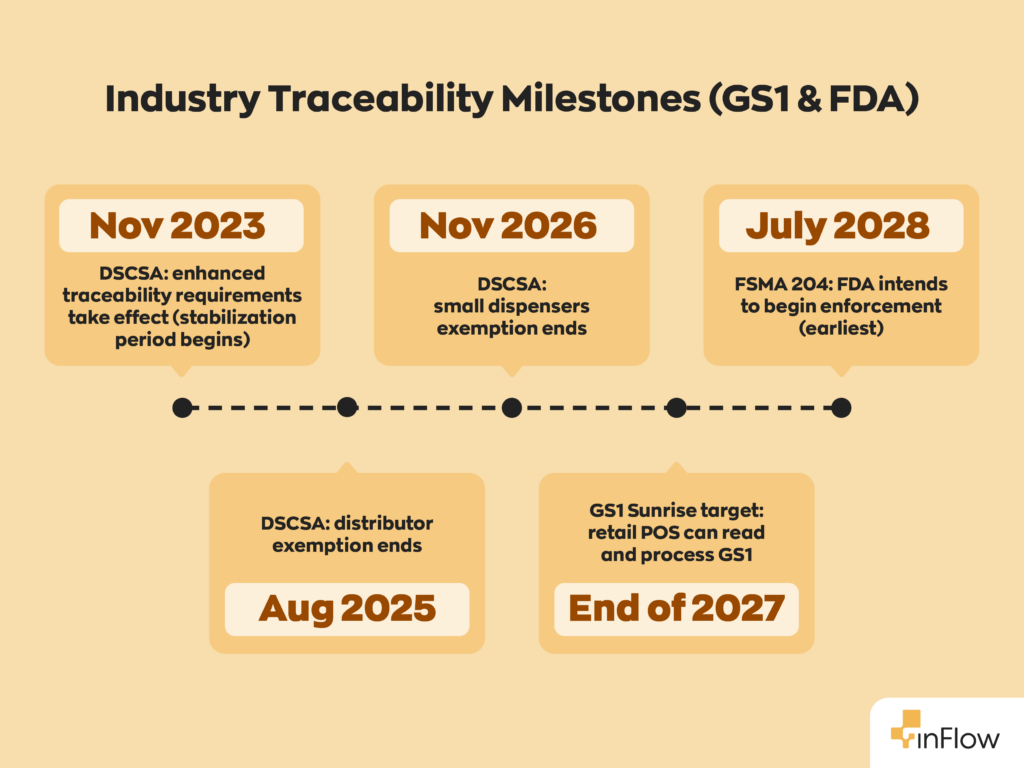
Industry-specific considerations
Just like your position in the supply chain shapes how Sunrise 2027 affects you, your industry plays a big role too. Let’s take a closer look at what this shift means in a few key sectors.
- Food and beverage: The food industry stands to benefit significantly from 2D barcodes, thanks to their enhanced traceability. With embedded expiration dates and batch information, food recalls can be more precise and efficient. Restaurants and grocery stores can better manage inventory rotation through systems like FIFO and reduce food waste.
- Pharmaceuticals and healthcare: Healthcare products already require extensive tracking for safety and regulatory compliance. 2D barcodes can streamline these processes by embedding lot numbers, expiration dates, and even dosage information directly in the barcode.
- Manufacturing and industrial: Manufacturers can use 2D barcodes to embed serial numbers, manufacturing dates, and quality control information. This enhances warranty tracking, maintenance scheduling, and quality assurance processes.
Of course, these are just a few examples. The real takeaway here is that 2D barcodes adapt to the needs of your industry and will have varying impacts depending on the industry.
The role of modern inventory management
As businesses prepare for Sunrise 2027, having robust inventory management systems becomes increasingly important. The enhanced data capacity of 2D barcodes is only valuable if your systems can capture, store, and utilize that information effectively.
That’s why so many businesses trust inFlow for all their inventory and barcoding needs. It can help businesses bridge the gap between current operations and Sunrise 2027 requirements by supporting multiple barcode formats, lot and batch tracking, expiration date management, and serial number tracking.
We even have a built-in barcode label designer that makes creating beautiful barcode labels simple.
Conclusion
GS1 Sunrise 2027 is a significant evolution in how businesses identify, track, and manage products. While the transition may seem overwhelming, the gradual transition will give businesses time to adapt at their own pace.
The key is to start planning now. Assess your current systems, understand your industry’s specific requirements, and develop a phased transition strategy. The sunrise is already underway; the question is whether your business will be ready to make the most of it.
FAQ
What is GS1 Sunrise 2027?
GS1 Sunrise 2027 is a global initiative to transition from traditional 1D barcodes to 2D barcodes at point-of-sale systems by 2027.
Do I have to replace all my barcodes by 2027?
No, you don’t need to replace all your barcodes by 2027. The transition includes a long coexistence period during which both 1D and 2D barcodes will coexist.
What’s the difference between 1D and 2D barcodes for inventory management?
1D barcodes store basic product identification, while 2D barcodes can store thousands of characters, including lot numbers, expiration dates, serial numbers, and links to digital product information.
Will my current barcode scanners work with 2D barcodes?
Many modern barcode scanners already support 2D barcodes, but older laser-only scanners may need to be upgraded to camera-based or hybrid scanners.
Is Sunrise 2027 compliance mandatory?
Sunrise 2027 is not a regulatory requirement; it’s an industry readiness initiative. However, businesses that don’t adapt may face competitive disadvantages as customers and partners increasingly expect enhanced product data and traceability capabilities.
Does Sunrise 2027 only benefit large retailers?
No. While large retailers may drive adoption, the benefits of enhanced product data apply to businesses of all sizes.
0 Comments