



Key takeaways
- Perform an inventory reconciliation against the general ledger at every month-end, pulling the system report and the ledger balance as of the same cutoff date.
- Settle the cutoff date, costing method, and GL accounts first. A bad setup creates variances that no journal entry can honestly fix.
- Roll both sides forward from the same opening balance to find where the gap opened, then fix that cause.
- Never post a plug entry. Find the cause first, and book each correction on the side that missed the transaction.
- Keep a preparer, a reviewer, and a saved workpaper every month, so you can defend the number to auditors, lenders, and buyers.
- Call an accountant when the same variance repeats, months sit unreconciled, or stock moves across several channels or locations.
To match your inventory system to the general ledger, compare both balances at the same cutoff date, roll each one forward from the same opening balance, trace every difference to its source, and post corrections only for causes you can prove.
If the inventory report shows one number while the balance sheet shows another, you know how much time that gap eats. Nobody trusts the margins. The close drags. Every question from a lender or buyer turns into a scramble. And you’re not alone.
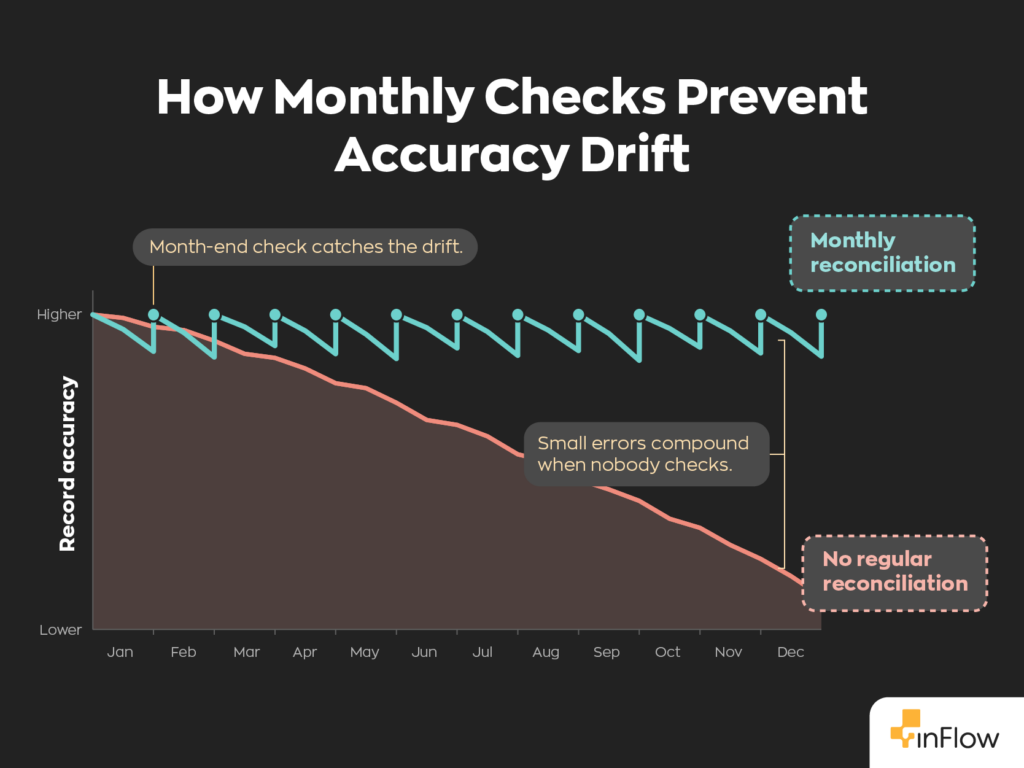
A study of nearly 370,000 inventory records from 37 stores of one retailer found that 65% were inaccurate. That study looked at inventory quantity records, not ledger balances, but the lesson holds: records drift unless someone checks them on a schedule. inFlow’s own 2026 survey points the same way: 49.5% of operators named inventory accuracy as an area needing improvement, the most common answer on the list.
The fix is a month-end routine any accountant would recognize. Set the ground rules, tie out the two balances, explain every difference, and post entries that fix causes instead of covering symptoms. It takes six steps, and you run them in the same order every month.
Consistent practice leads to a clear balance sheet, reliable cost of goods sold, and smoother inventory closes. By the end of this guide, you’ll know how to run the reconciliation, what usually causes the gap, and when to bring in an accountant.
What is inventory reconciliation, and why don’t your inventory report and general ledger match?
Inventory reconciliation is the month-end process of proving that your inventory system and your general ledger show the same inventory value. The two disagree because they record the same events at different times, at different costs, or not at all.
Here’s how the two records split the work. The inventory system, your subledger, tracks quantity and cost for every item. The general ledger (GL) tracks the inventory asset on your balance sheet and cost of goods sold (COGS) on your income statement. Say the subledger shows $412,600 and the GL shows $405,900. You now have a $6,700 variance, and someone has to explain it.
Your inventory method affects the number of errors that happen. A perpetual system updates inventory records every time you receive or sell items. A periodic system waits until the end of a period to physically count items and then calculates the cost of goods sold (COGS) based on that count. Most inventory software uses a perpetual system, which makes it easier to reconcile each month.
This is important because the inventory number affects COGS, gross profit, and taxable income. If you overstate your inventory, you reduce COGS, which increases profit and taxes. If you understate inventory, the opposite happens. In both cases, your financial statements will be wrong, which can mislead lenders, investors, and buyers. Ignoring a gap today will likely make it worse over time.
Most gaps come from common issues like missing bills, unrecorded freight, manual journal entries, sync errors, and count adjustments that show up only in one record. You will see details of these causes in the table later in this guide. Before you begin, make sure your setup is clean.
What should you check before reconciling inventory to the general ledger?
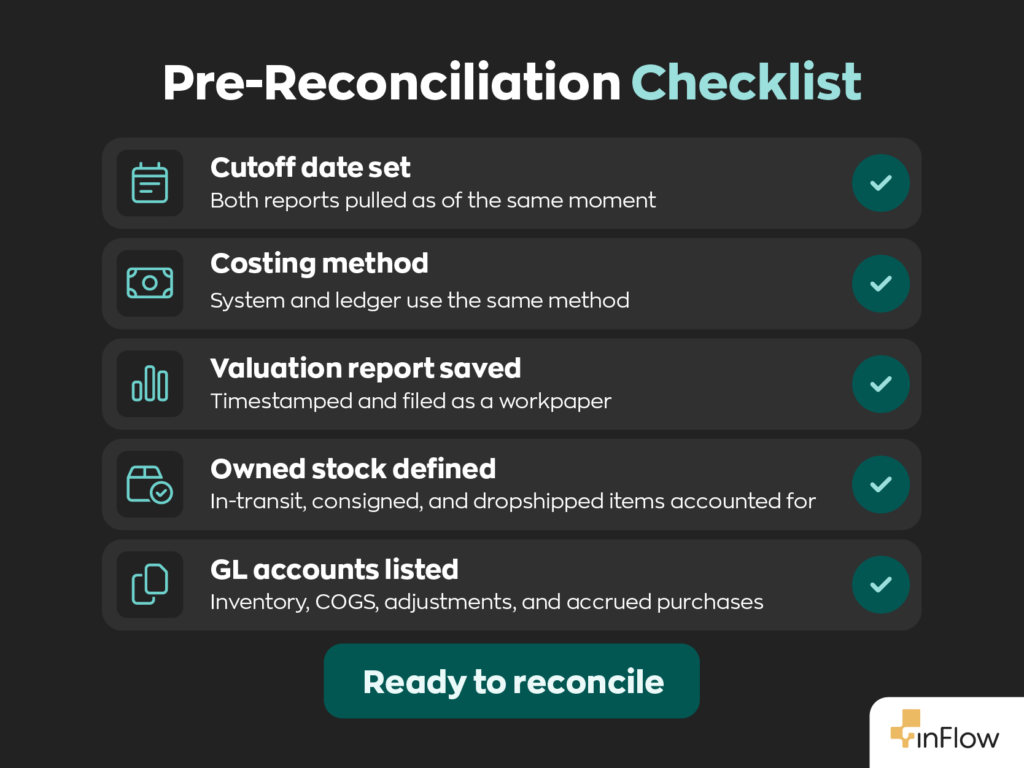
Before comparing any number, check these five things: the cutoff date, the costing method, a saved valuation report, what counts as your stock, and which general ledger (GL) accounts you’ll use. A reconciliation goes off track when the setup is wrong, not just when the calculations are incorrect.
- Set a clear cutoff date: Choose the exact date and time, usually the last day of the month, and gather all reports as of that moment. If you run a subledger report three days later, it may include receipts that the ledger hasn’t recorded yet.
- Confirm the costing method: Make sure the system and the ledger use the same costing method. If you’re unsure, review how FIFO (First In, First Out) and LIFO (Last In, First Out) work. A mismatch in methods can lead to differences that keep coming back until the methods match.
- Save the valuation report with a timestamp: Inventory systems change as transactions are recorded. If you can’t reproduce a report later, you can’t defend its accuracy, so file it as a workpaper.
- Compare similar items: The quantity you own isn’t always the same as the quantity on hand. Goods in transit, consigned stock, and dropshipped items may show up in one record but not in another. Decide where each type belongs before you compare totals.
- List the involved GL accounts: This list usually includes the inventory asset, cost of goods sold (COGS), inventory adjustments, and received-but-not-billed (accrued purchases). Understand where each transaction type belongs before you start tracing.
If you can’t check all five items, that’s your first clue. Fix the setup, and the rest of the reconciliation will go much faster. A clear setup also makes it easier for a reviewer, auditor, or new hire to understand the workpaper.
How do you reconcile inventory to the general ledger, step by step?
Reconciling inventory to the general ledger is done in the following steps: pull both balances at the cutoff, compute the variance, roll both sides forward, explain each difference, post corrections, and have a second person review. Run them in this order every month.
Step 1: Get the inventory valuation report at the cutoff date. This is your subledger total.
Step 2: Find the GL inventory balance on the same date from the trial balance or account detail.
Step 3: Calculate the difference and note if it’s positive or negative. If the system total is higher than the ledger, check for any receipts or costs that the GL hasn’t recorded yet.
Step 4: Update both sides using the same formula: opening balance + purchases − COGS ± adjustments = closing balance. Compare each part, not just the overall totals. There is probably a gap in one of the components.
Step 5: Break down the variance step by step. Track each difference to find where the issue started, and only stop when the explained amounts add up to the full variance.
Step 6: Make the necessary corrections, then review the work. Have someone who didn’t prepare the reconciliation sign off, and file the workpaper.
Here’s a quick example: The system shows $412,600, and the GL shows $405,900, leading to a $6,700 gap. The analysis shows three reasons: $4,200 of goods received but not billed, $1,900 of freight that the GL recorded as an expense instead of a capital cost, and a $600 count loss recorded in the GL but not entered in the system. The first two adjustments go into the ledger, updating it to $412,000. The third adjustment goes into the system, lowering the subledger to $412,000. Now both sides match.
Notice where the fix landed. It doesn’t always belong on the side you’re staring at.
What causes inventory and general ledger differences, and where should you look?
Most inventory and general ledger differences come from nine main causes: timing of receipts and bills, landed costs, manual journal entries, syncing errors, returns, negative inventory, kits, unposted count variances, and activities across multiple locations or channels.
Match what you see to the table:
| Symptom | Likely cause | Where to look | Fix |
| System higher, no bill in GL | Receipt and bill timing | Receipts without bills | Accrue received-not-billed; reverse on billing |
| System cost above GL | Landed cost left out | Freight, duty, handling invoices | Capitalize into inventory |
| GL moves, system doesn’t | Manual journals | Inventory account detail | Reverse; re-enter as an inventory transaction |
| Variance after a sync | Mapping or sync errors | Integration logs, mappings | Fix the mapping; re-sync |
| Sales and stock off after returns | Returns and credit memos | Credits against return receipts | Match credits to restocks and COGS |
| Negative on-hand quantity | Sold before receipt recorded | Items with negative stock | Record receipts; review costs |
| Kit sells, components stay | Bundles and kits | Component setup | Fix components; adjust items |
| Counts done, no adjustment | Unposted count variances | Count sheets against journals | Post approved variances |
| Totals differ by site | Multiple locations or channels | Valuation by location | Reconcile each; check transfers |
Multichannel sellers hit the last row hardest, since each marketplace settles sales, fees, and returns differently. That reconciliation is core ecommerce accounting work.
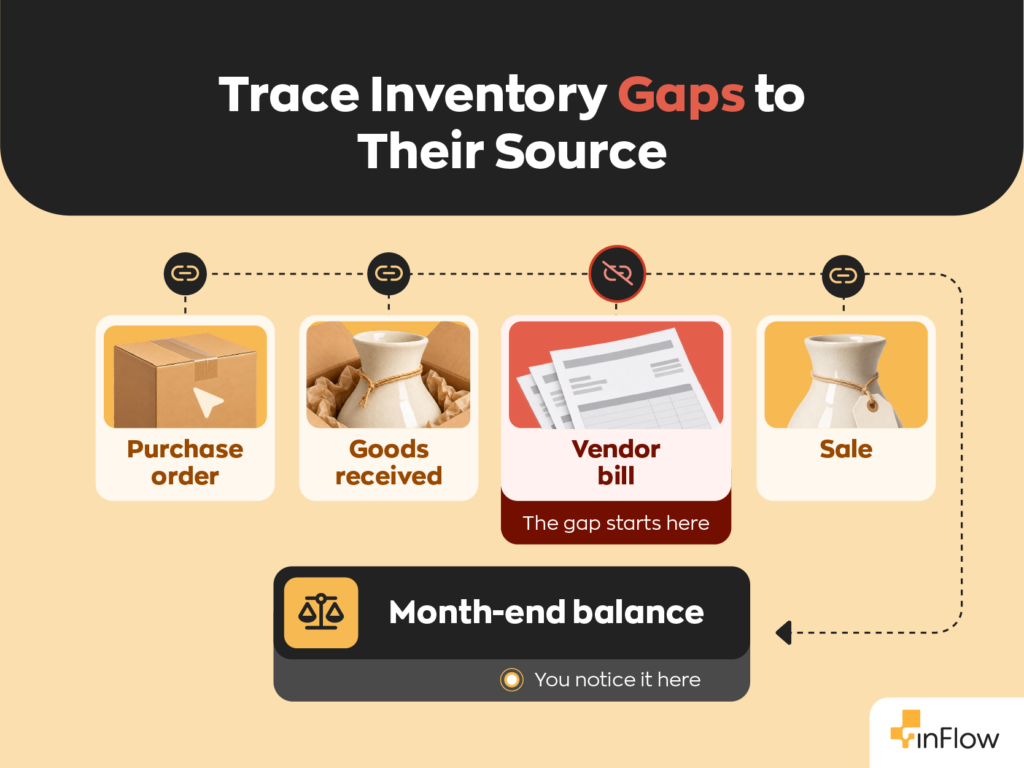
Most gaps start earlier in the chain than the balance you’re looking at. A $6,700 variance isn’t one problem. It’s usually two or three small ones stacked together. So don’t start at the total. Start at the first transaction that broke, and work forward from there.
If the same row keeps showing up month after month, you’ve found a process problem, not a one-off error. Later in this guide you’ll see what to do about it.
Which journal entries should you post to fix an inventory variance?
Match the cause to the correct accounting entry. A count variance calls for a debit to inventory adjustment (COGS) and a credit to inventory. When goods arrive before the vendor bill, record a debit to inventory and offset it with accrued purchases. Landed costs get added to the inventory balance, with the credit going to payables or freight clearing. Apply cost corrections to COGS.
Here are the four entries you’ll use most:
- Shrinkage or count variance: Dr Inventory adjustment (COGS), Cr Inventory. Missing stock that never sold counts as inventory shrinkage and increases COGS.
- Goods received, not billed: Dr Inventory, Cr Accrued purchases. Reverse it when the vendor bill arrives so you don’t count the purchase twice.
- Landed cost: Dr Inventory, Cr Accounts payable or freight clearing.
- Cost correction: Dr or Cr Inventory against COGS, depending on the direction of the error.
Remember this important rule for your monthly checklist: never use a plug entry. A plug entry matches the ledger to the report using an unclear debit or credit. This gives a false sense of completion and leads to the same problem returning next month, often worse. Auditors, lenders, and buyers quickly spot plugs and will question what else has been ignored.
To keep your entries accurate, do two things: First, attach supporting documents, such as receipts or bills, to each entry. Second, correct the mistake in the right place. If the ledger has already recorded a loss, fix it there instead of recording it twice.
Account names can vary by system, so confirm with your accountant before making entries. If stock is worth less than you paid, that’s a separate issue, not a reconciliation matter.
How do you make inventory reconciliation a monthly habit?
Make inventory reconciliation a monthly habit by putting it on the close calendar, giving it an owner and a reviewer, setting a written tolerance, and logging the variance every month.
- Reconcile before you close: If you close first, every later correction lands in a period you’ve already reported, and you end up explaining prior-period adjustments.
- Name a preparer and a reviewer: One person prepares the reconciliation, and a different person reviews it. Keep the workpaper, the valuation report, and the support in one folder.
- Set a written tolerance: Choose the size of difference to investigate and note smaller ones without pursuing them. Always check any recurring variance, no matter how small. Your accountant can help you set an appropriate threshold.
- Log the variance every month: A running list of month, variance, and cause shows whether the gap is shrinking. It also gives an accountant a head start if you ever need one.
- Automate the routine matching: Tools that sync payments and map payment methods to the right accounts, like inFlow’s Xero integration, cut out much of the double entry that creates variances. A person still reviews the exceptions.
- Count on a cycle: The reconciliation proves the dollars agree. Cycle counts prove the quantities behind those dollars are real. Rotate through high-value items more often than slow movers.
This is the same idea behind the retail study from the intro, which found that inventory auditing practices reduce record inaccuracy. A monthly reconciliation applies it to your ledger and catches small errors while they’re still cheap, instead of leaving twelve months of them for year-end. And if your log shows the same cause month after month, you’ve outgrown the routine. That’s what the next section covers.
What should you do when the inventory gap keeps coming back?
When the inventory gap keeps coming back, treat it as a structural problem and choose one of three fixes: repair the process, upgrade your tools, or bring in an accountant. Your variance log from the monthly routine tells you which one.
Read the log first. Three signs point to a structural problem: the same cause shows up month after month, several months sit unreconciled, or stock moves across multiple channels and locations.
Fix the process when one or two causes explain most of the variance. Trace how receipts, bills, freight, and returns flow into the ledger. Many recurring gaps come from a single bad mapping or a manual journal habit, and fixing that one step often clears the gap.
Upgrade your tools when you track stock in spreadsheets or in your accounting software alone. Migrating to dedicated inventory software gives you a subledger that updates with every transaction, which removes a whole category of timing errors. Software records a broken process faster, though, so reconcile the inventory asset in both systems before you go live.
Bring in an accountant when months have piled up, the variances trace to no clear cause, or a lender, auditor, or buyer needs numbers you can defend. An accounting firm such as Ledger Labs starts by finding where your books and your warehouse disagree, then reconciles inventory to your books every period through its inventory management accounting services.
Not sure which fits? Match what the log shows to the fix. One dominant cause points to the process. Spreadsheet-based tracking points to tools. A backlog or an unexplained variance points to an accountant. Whichever you choose, the FAQ below answers the questions owners ask most.
FAQs
How often should you reconcile inventory to the general ledger?
Reconcile at every month-end, before you close the books. If you sell through several channels or hold stock in several locations, add a mid-month check. Monthly keeps small variances small and stops year-end from turning into a cleanup project.
What is the difference between a physical count reconciliation and a GL reconciliation?
A physical count reconciliation compares the quantities on your shelves with the quantities in your system. A GL reconciliation compares the system’s dollar value with the ledger balance. Fix quantities first through counts, then confirm the dollars through the GL tie-out.
Who should review an inventory reconciliation?
Someone who didn’t prepare it. That could be your controller, a senior bookkeeper, or an outside accountant. The reviewer checks that the variance is fully explained, the support is attached, and the entries make sense.
What is the journal entry for an inventory adjustment?
For a shortage found in a count, debit an inventory adjustment or COGS account and credit inventory. For an overage, reverse it: debit inventory and credit the adjustment account. Post it only after the count is approved and the cause is documented.
What should you hand your accountant to get started?
Give them the inventory valuation report at the cutoff, the GL inventory account detail, the latest count sheets, open purchase receipts and vendor bills, freight invoices, and a list of manual journals to inventory. That’s enough to start the rollforward.
0 Comments