 Fellow Canadians: All inFlow plans are available in Canadian dollars





Key takeaways
- The bullwhip effect happens when small changes in customer demand become amplified as they move up the supply chain from retailers to suppliers.
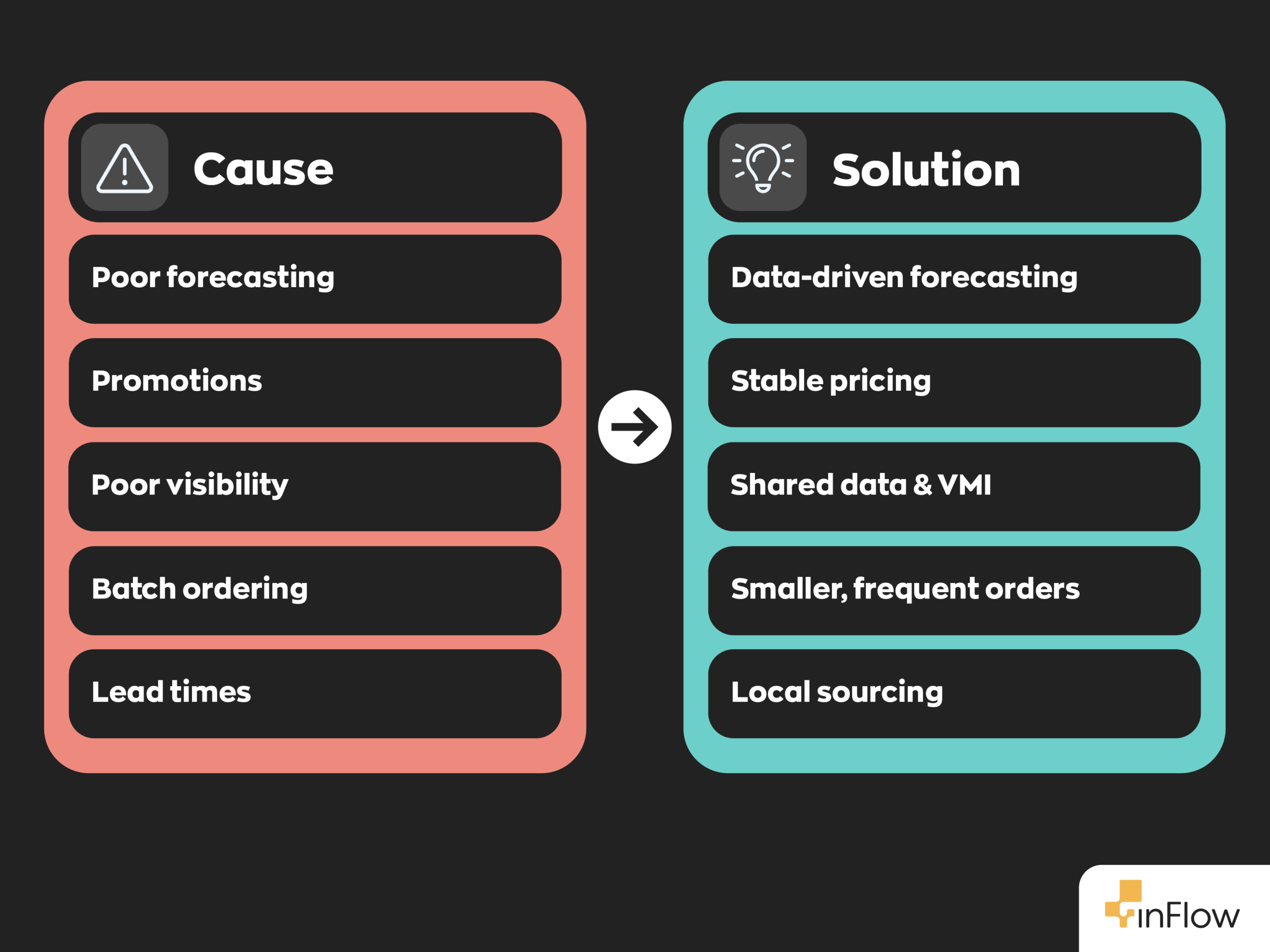
- Poor forecasting, batch ordering, price promotions, inconsistent lead times, and limited supply chain visibility are major causes of the bullwhip effect.
- The COVID-19 toilet paper shortage is a classic example of the bullwhip effect, where modest increases in consumption triggered massive overordering throughout the supply chain.
- The bullwhip effect can lead to stockouts, excess inventory, higher storage costs, inefficient production planning, and reduced profit margins.
- Businesses can reduce the impact of the bullwhip effect by improving demand forecasting, sharing real-time data, placing smaller and more frequent orders, and reducing lead times.
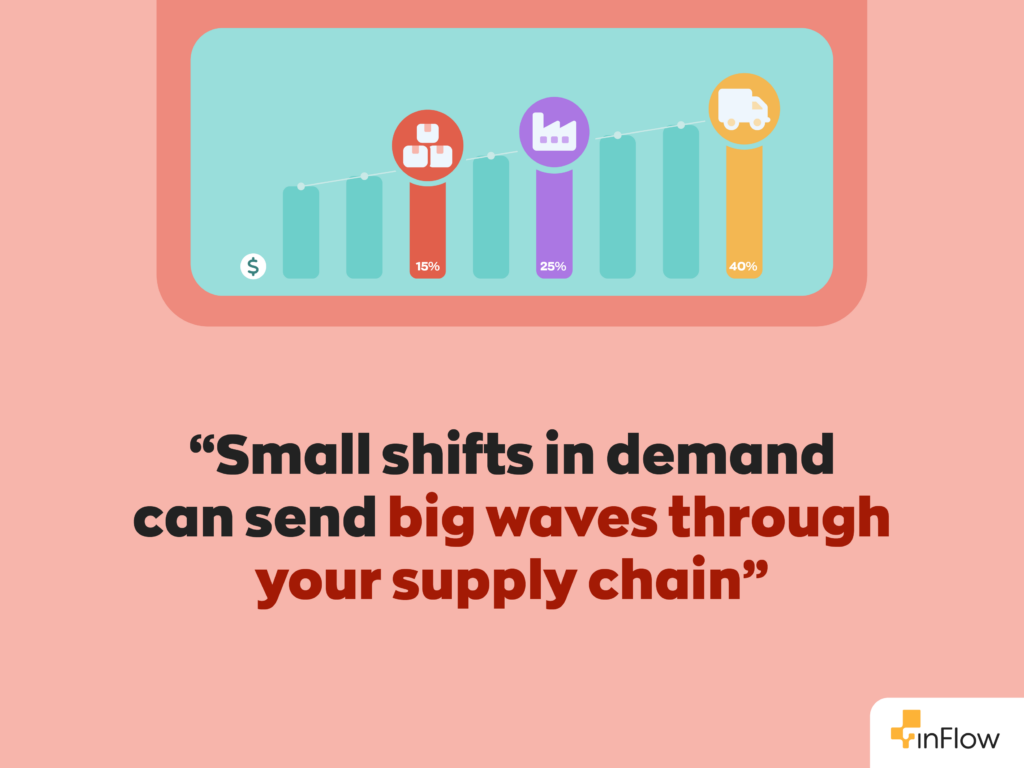
Here’s a scenario that’ll sound familiar to some manufacturers: A customer places an order that’s a bit larger than usual, say 15%. Nothing dramatic, just a slight bump they chalk up to seasonal demand. So you increase your production order by 25%. Just to be safe. That means ordering more raw materials. Your supplier, seeing your larger order, assumes demand is surging and ramps up their procurement by 40%.
What started as a modest 15% uptick has now created a 40% spike in raw material demand. This is the bullwhip effect, one of supply chain management’s most persistent and costly challenges.
But how does it actually happen, and more importantly, what can you do to stop it? Let’s find out.

What is the bullwhip effect?
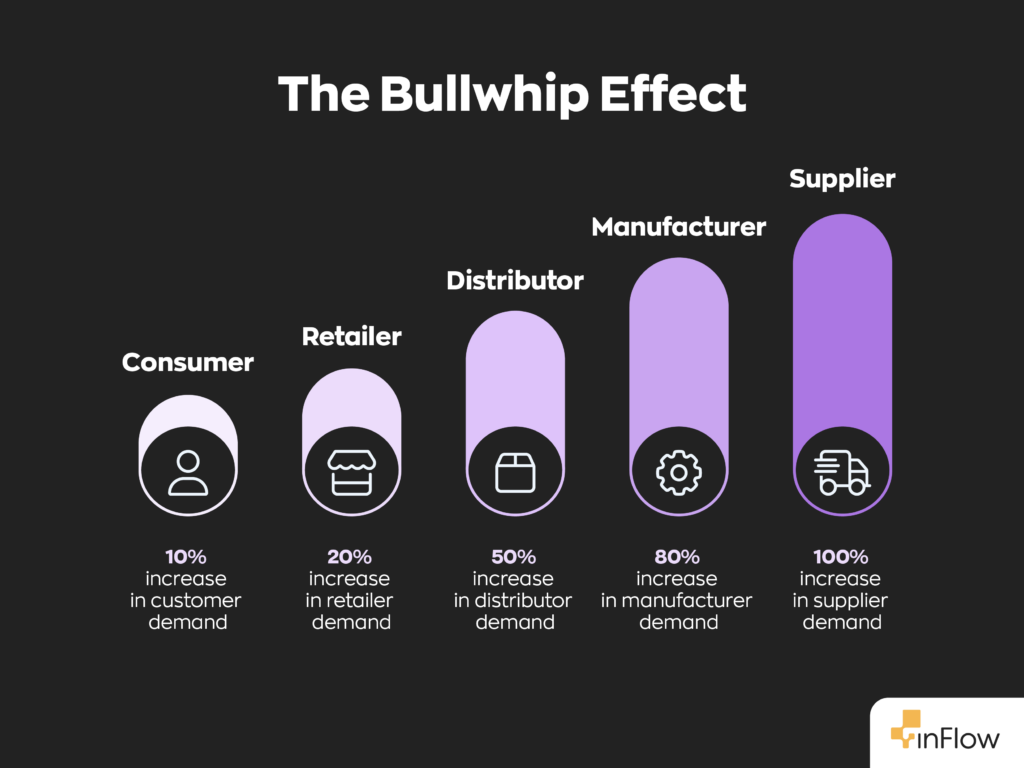
The bullwhip effect is a supply chain phenomenon where demand variability increases as you move up the supply chain from retailers to wholesalers to manufacturers to suppliers. In other words, the further you get from the end customer, the more volatile and unpredictable orders become.
Like the crack of a bullwhip, where a slight wrist movement creates an amplified motion at the tip, minor changes in end-customer demand can cause massive disruptions for manufacturers and suppliers.
The term was coined by researchers at Procter & Gamble in the 1990s, when they noticed that, despite relatively stable consumer demand for Pampers diapers, retailers’ orders varied dramatically. This created a ripple effect throughout their supply chain, leading to inefficiencies and increased costs.
How the bullwhip effect works
You can think of your supply chain as a game of telephone. Each person receives information about demand and interprets that information before passing it along. Here’s what typically happens:
- End customers make purchasing decisions based on their actual needs.
- Retailers observe sales patterns and place orders with some buffer for safety stock.
- Distributors see orders coming in from retailers and add their own safety margins.
- Manufacturers receive orders from their distributors and plan production with additional buffers.
- Raw material suppliers scale up procurement to meet higher production forecasts.
As information trickles down the supply chain, each level interprets what’s needed and adjusts its safety buffer accordingly. This amplifies the original demand signal until it becomes distorted beyond recognition.
A real-world example: the 2020 toilet paper shortage
For a textbook example of the bullwhip effect in action, we only need to look back to the COVID-19 pandemic:
- Consumer Level – When lockdowns began, people shifted toilet paper consumption from commercial facilities to homes. The actual increase in total consumption was around 40%.
- Retail Level: Seeing empty shelves and panicked customers, retailers increased their orders by 50-100% to ensure adequate stock.
- Distribution Level: Distributors observed these massive order increases from multiple retailers and assumed demand had permanently shifted, increasing their orders by 200-300%.
- Manufacturing Level: Manufacturers saw unprecedented order volumes and ramped up production while increasing raw material orders.
- Supplier Level: Suppliers, reacting to soaring orders from manufacturers, ramped up procurement and secured extra materials, assuming long-term demand.
The result? A minor shift in consumption created severe retail shortages despite adequate production capacity. When the lockdowns ended and people returned to public spaces, companies found themselves with massive excess inventory.

Major causes of the bullwhip effect
There are numerous contributing factors for the bullwhip effect, but some of the major ones to keep in mind are as follows.
Demand forecasting errors
Poor demand forecasting is perhaps the biggest contributor to the bullwhip effect. When companies rely solely on historical data without considering current market conditions, forecasting errors work their way up the supply chain. A retailer’s 10% error becomes a distributor’s 20% error, which becomes a manufacturer’s 40% error, and so on.
Batch orders
Many companies place large, infrequent orders to take advantage of discounts or reduce shipping costs. This creates artificial demand spikes that don’t reflect actual consumption patterns, making it nearly impossible for suppliers to understand the true underlying demand.
Price fluctuations and promotions
Promotional pricing can create artificial demand patterns. When companies offer discounts, customers buy more than they need. Suppliers interpret these spikes as genuine demand increases and adjust production accordingly.
Inconsistent lead times
Long or unpredictable lead times force companies to place orders well in advance, reducing forecast accuracy and encouraging the buildup of safety stock. When lead times are inconsistent, companies often overcompensate by ordering even more inventory.
Poor communication and visibility
Information siloing means each level of the supply chain will make decisions based on incomplete data. Without visibility into actual consumer demand, suppliers must rely on order patterns from immediate customers, which may not reflect actual market conditions.
Consequences of the bullwhip effect
There are significant business implications associated with the bullwhip effect. Here are some to keep in mind.
Inventory management challenges
The bullwhip effect creates stockouts when companies can’t increase production quickly enough, and excess inventory when artificial demand disappears. Higher inventory levels mean more money tied up in inventory, increased storage costs, and higher risks of dead stock.
Operational inefficiencies
Volatile order patterns make production planning difficult. You might find yourself paying employees overtime during periods of apparent demand spikes, only to face idle hands once orders fall back to normal. Companies may even invest in increasing their output capacity in response to inflated demand signals, only to discover that these investments were unnecessary.
Financial impact
The bullwhip effect drives up costs throughout the supply chain: increased inventory carrying costs, expedited shipping fees, overtime labor expenses, and emergency procurement costs. These inefficiencies directly impact profit margins and strain supplier relationships.
Strategies to minimize the bullwhip effect
While there’s no way to eliminate the bullwhip effect entirely, there are some strategies to help you mitigate the impact it has on your business.
Improve demand forecasting
Work closely with customers and suppliers to share information through sales and purchase orders. Implement advanced analytics and forecasting tools, such as StockTrim, to identify patterns while accounting for market changes and seasonality.
Enhance information sharing
Consider vendor-managed inventory (VMI) programs where suppliers manage inventory based on actual consumption data. Implement electronic data interchange (EDI) systems and supply chain visibility platforms that provide real-time information sharing.
Optimize ordering patterns
Move toward smaller, more frequent orders that better reflect actual consumption. Minimize promotional pricing that encourages forward buying, and work with suppliers to establish flexible minimum order quantities.
Reduce lead times
Develop suppliers to streamline processes and reduce lead times. Consider local sourcing to minimize transportation time and identify bottlenecks in your own processes that contribute to longer lead times.
How inFlow can reduce the impact of the bullwhip effect
Managing the bullwhip effect requires accurate, real-time visibility into your inventory and demand patterns, and that’s exactly what inFlow provides.
- Real-time Tracking: inFlow gives you instant visibility into stock levels across multiple locations, helping you make informed ordering decisions based on actual inventory rather than guesswork.
- Advanced Forecasting: The software analyzes historical sales data to identify trends and seasonal patterns, providing more accurate demand forecasts that reduce excessive safety stock.
- Automated Reorder Points: Set up intelligent reorder points that trigger purchase orders when inventory reaches certain levels, eliminating guesswork and reducing batch orders.
- Supplier Management: Track supplier performance, lead times, and reliability to make better sourcing decisions and reduce supply chain uncertainty.
By providing the visibility and control you need for data-driven inventory decisions, inFlow helps break the cycle of demand amplification that creates the bullwhip effect.
Final thoughts
The bullwhip effect is one of supply chain management’s most persistent challenges. However, by understanding what causes it and applying targeted strategies such as better forecasting, clearer communication, and shorter lead times, you can significantly reduce its impact.
Don’t let the bullwhip effect damage your supply chain efficiency. Start by examining your current inventory management processes and identifying areas where better visibility can smooth out demand signals. Your bottom line will thank you for it.
FAQ
What is the bullwhip effect in supply chain management?
The bullwhip effect is a supply chain phenomenon where small changes in consumer demand create increasingly larger fluctuations as you move up the supply chain from retailers to manufacturers to suppliers. Like cracking a bullwhip, minor demand shifts can cause massive disruptions for upstream suppliers, leading to inventory shortages or excess stock.
What causes the bullwhip effect?
The main causes include poor demand forecasting, batch ordering patterns, price promotions, inconsistent lead times, and lack of communication between supply chain partners. Each level adds safety stock buffers, amplifying the original demand signal. Information silos prevent companies from seeing actual consumer demand, forcing them to react to distorted order patterns.
How does the bullwhip effect impact businesses?
The bullwhip effect increases inventory carrying costs, creates stockouts and excess inventory, disrupts production planning, and strains supplier relationships. Companies face higher operational costs from overtime labor, expedited shipping, and emergency procurement. These inefficiencies directly impact profit margins and make demand planning extremely difficult.
What are effective strategies to mitigate the bullwhip effect?
Key strategies include improving demand forecasting through real-time data sharing, implementing vendor-managed inventory programs, placing smaller, more frequent orders, reducing lead times through local sourcing, and enhancing communication between supply chain partners.
Can the bullwhip effect be completely eliminated?
While the bullwhip effect cannot be completely eliminated, its impact can be significantly reduced through proper supply chain management practices. Companies that implement data sharing, improve forecasting accuracy, and maintain strong supplier relationships experience much less demand volatility. The goal is to minimize amplification rather than eliminate it.
How does the bullwhip effect influence inventory management?
The bullwhip effect makes inventory management extremely challenging by creating unpredictable demand patterns that lead to either stockouts or excess inventory. Companies struggle with accurate reorder points, safety stock calculations, and production planning. This volatility increases carrying costs, storage requirements, and the risk of dead stock while making it difficult to maintain optimal inventory levels.
0 Comments