 Fellow Canadians: All inFlow plans are available in Canadian dollars





Key takeaways
- OEM and ODM sit at opposite ends of the design-ownership spectrum: with OEM, you design the product and the manufacturer builds it; with ODM, the manufacturer designs and builds it, then sells the same product to multiple brands.
- IP and tooling ownership are the real dividing line between the two models. OEM buyers typically own the design, IP, and molds (even if they physically sit at the manufacturer’s plant); ODM manufacturers usually retain all three.
- ODM is faster and cheaper to get to market since the design and tooling already exist, but you’re accepting real competitive risk, since a competitor can source the exact same product.
- OEM demands a much bigger upfront investment in R&D, prototyping, and tooling, with no guarantee the investment pays off.
- Related models like white-label, private-label, contract manufacturing, and OBM overlap with OEM and ODM in ways that often get confused, and knowing the distinctions helps you ask manufacturers the right questions upfront.
- The agreement you sign matters as much as the model you choose. IP ownership, tooling rights, exclusivity terms, and compliance responsibility should all be spelled out in writing, not assumed.
There are many manufacturers out there, many of which you’ll probably never hear about. At the same time, pretty much every manufacturer belongs to one of two categories. They’re either an original equipment manufacturer (OEM) or an original design manufacturer (ODM). So, what’s the difference between OEM vs ODM?
If you’re just starting out on the manufacturing side of things, figuring out which is which can be confusing. And then there’s the question of which one is best for you. Today, we’ll answer those questions, and by the end, you should have a clear idea of which direction to go.
Before we start, it’s worth noting that the term “OEM” means something slightly different depending on the industry. For the sake of this article, we’re focusing on what it means for manufacturing specifically.
OEM vs ODM: quick reference comparison table
If you’re short on time, here’s the whole debate in one table.
| Factor | OEM | ODM |
|---|---|---|
| Who designs the product | Buyer | Manufacturer |
| Who owns the IP | Buyer (typically) | Manufacturer (typically) |
| Customization | High | Low to moderate |
| Upfront R&D cost | High | None to minimal |
| Unit cost at scale | Higher until volume kicks in | Lower, thanks to shared production runs |
| Minimum order quantity | Often lower, but negotiable | Often higher, since it’s a shared product line |
| Lead time | Longer (design + tooling + production) | Shorter (design already exists) |
| Exclusivity | High | Low — other brands may sell the same product |
| Best for | Flagship, differentiated products | Generic, low-differentiation products |
We’ll unpack every row of this table in detail below, so keep scrolling.
What is OEM manufacturing?
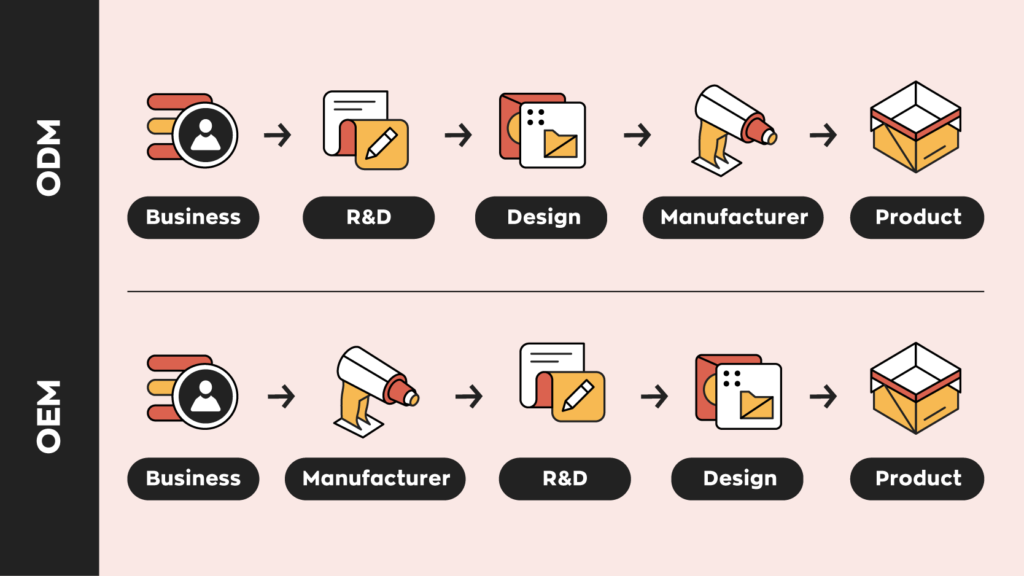
An OEM manufactures products based on design specifications given to them by another company. For example, Google researches, designs, and develops its Pixel line of phones and then outsources them to Foxconn for mass production.
Some businesses, like Samsung, design and manufacture their products in-house. However, this is the exception, not the norm. Most businesses don’t have the resources to manage R&D and manufacturing departments simultaneously, which is precisely why the OEM model exists.
How the OEM manufacturing model works
In an OEM relationship, the work is split cleanly down the middle: you own the what, and the manufacturer owns the how.
Buyer responsibilities
As the buyer, you’re on the hook for:
- Designing the product (or hiring a design firm to do it)
- Creating detailed technical specifications and drawings
- Sourcing and approving components, where applicable
- Managing your own intellectual property and patents
- Covering the R&D costs and any tooling investment
Manufacturer responsibilities
The OEM, on the other hand, is responsible for:
- Building the product to your exact specifications
- Sourcing materials (unless you’ve specified otherwise)
- Running quality control against your standards
- Scaling production to meet your order volume
- Packaging and preparing goods for shipment
OEM advantages
As with any other business model, working with an OEM has both pros and cons.
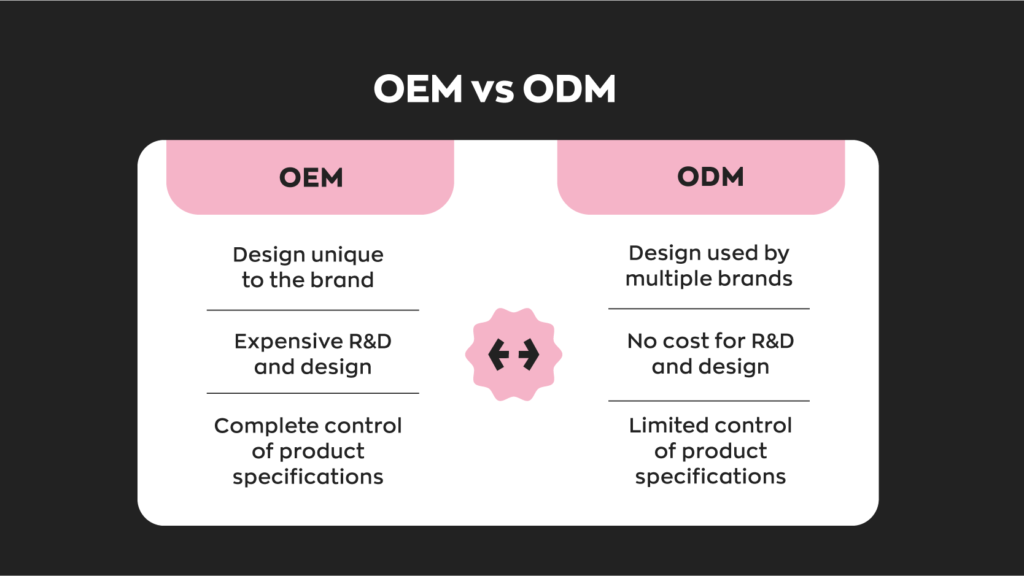
The biggest benefit of working with an OEM vs ODM is that you’re designing your own product. This means your business owns most (if not all) of the relevant IP. This results in near-total control of the product.
Designing a product from the ground up also means your business can tune it to pretty much any specification. This results in far greater flexibility, both for the product in question and for other products that may rely on it.
OEM disadvantages
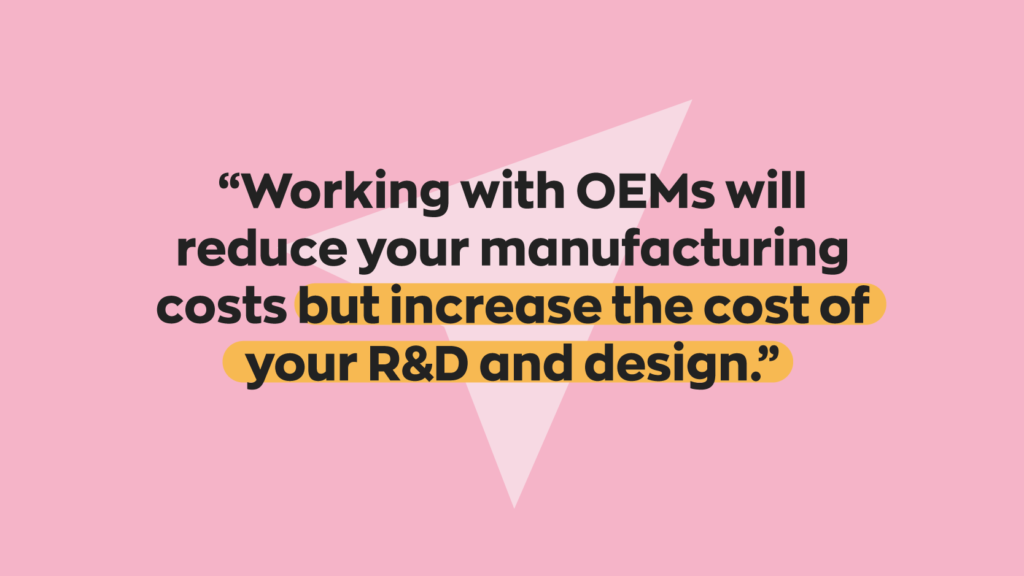
Unfortunately, designing your own product from the ground up comes at a cost…literally. The research and development (R&D) phase of product development is notoriously expensive. It takes a lot of time, sometimes years, which, in turn, ends up costing a lot of money. R&D projects are frequently scrapped, too, meaning there’s no real guarantee of a return on investment. Sinking potentially tens of thousands of dollars into a failed project isn’t an attractive prospect for any business. For smaller businesses, it can prove fatal.
For example, Samsung spent $14 billion on R&D in 2014, and that number only rises as time goes on. Samsung develops a lot of products, sure, but it’s still a good example of just how costly R&D can be.
OEM design, IP, and tooling ownership
With a true OEM relationship, you own the design, the IP, and, this is important, you typically own the tooling and molds too, even though they physically sit in the manufacturer’s facility. That ownership is what gives you leverage. If you’re ever unhappy with your OEM, you can (in theory) pack up your molds and take your business elsewhere. We say “in theory” because moving tooling isn’t cheap or fast, but the option exists, and that’s worth something.
Also, keep in mind this isn’t just the default for every OEM relationship. You need to ensure that background IP, supplier-created foreground IP, improvements, permitted use, assignment, confidentiality, and termination rights are all expressly allocated in contracts.
When OEM manufacturing is a good fit
OEM manufacturing makes the most sense when:
- The product is core to your brand identity (think: your flagship product, not an accessory)
- You need full control over specifications, materials, or performance
- You can absorb the upfront R&D cost and the risk that comes with it
- You’re playing a long game and want to build defensible IP
What is ODM manufacturing?
On the other hand, an ODM takes on both the design work and the manufacturing of products, then sells them to many different businesses. Those businesses typically slap their own branding on the product before selling it. For example, most phone chargers on the market are essentially the same thing; individual businesses just put their own branding on them.
How the ODM Manufacturing Model Works
With ODM, the manufacturer has already done the heavy lifting before you even show up.
Buyer Responsibilities
As the buyer, your job is mostly limited to:
- Selecting an existing product (or a near-existing product with minor tweaks) from the ODM’s catalog
- Applying your branding, packaging, and labeling
- Setting your retail pricing and marketing strategy
- Placing and managing your order volume
Manufacturer Responsibilities
The ODM handles:
- Designing and engineering the product
- Owning and maintaining the tooling
- Sourcing components and running production
- Offering the same base product to other brands, often simultaneously
ODM advantages
The biggest benefit of using an ODM vs OEM is that an ODM eliminates the R&D phase entirely (most of the time). This means working with an ODM is exponentially cheaper.
Generally speaking, it’s also easier for an ODM to scale its manufacturing process. Because they manufacture so much of a specific product, the cost per unit is lower, resulting in a lower price for you.
ODM disadvantages
On the other hand, working with an ODM has its own fair share of costs. Some of these are more abstract, meaning it can be harder to tell what the “real” cost is.
Working with an ODM means there’s a good chance you’re selling the exact same product as someone else. They just look a bit different from one another, and only on the surface level. This can make it difficult to stand out from competitors, especially if they offer a lower price. Someone looking for a new phone charger isn’t going to care about the brand; they just want the cheapest one available.
This can result in a handful of other issues. You may need to track competitors and re-evaluate your prices. A cost that adds up over time. On a more abstract level, this could harm brand identity, which carries its own negative implications.
ODM design, IP, exclusivity, and tooling
Unlike OEM, the ODM typically owns the design, the tooling, and the underlying IP. You’re licensing access to a product, not commissioning one from scratch. That also means exclusivity is rarely guaranteed unless you negotiate for it specifically (and pay for the privilege). If exclusivity matters to your brand, it’s worth asking about it up front. Some ODMs will offer a limited exclusivity window or region-locked exclusivity for a premium, but don’t assume it’s included by default.
When ODM manufacturing is a good fit
ODM manufacturing makes sense when:
- The product is generic or low-differentiation by nature (chargers, basic accessories, commodity goods)
- Speed to market matters more than uniqueness
- You want to test a new product category without a big R&D commitment
- You’re comfortable with the possibility that competitors may sell a near-identical product
OEM vs ODM: key differences compared
Now that you have a better idea of what OEM and ODM are on their own, let’s break the comparison down piece by piece. This should really help you decide which one is right for your business.
Product design and engineering responsibility
With OEM, the design work is entirely on your plate (or your hired designer’s). With ODM, the manufacturer has already engineered the product before you ever place an order.
Intellectual property and design ownership
This is one of the biggest differentiators. With OEM, you typically walk away owning the design and IP outright. With ODM, the manufacturer usually retains ownership, since the design was theirs before you got involved.
Tooling and mold ownership
OEM buyers commonly own their molds and tooling, even if it sits at the manufacturer’s plant. ODM buyers are usually working with molds the manufacturer already owns and reuses across multiple clients.
Customization and product differentiation
OEM gives you near-limitless customization since you’re building from a blank slate. ODM customization is usually limited to surface-level tweaks: color, branding, packaging, and maybe minor component swaps.
Upfront development cost and unit cost
OEM carries a high upfront cost (R&D, design, tooling) but can offer competitive unit costs at scale, especially since you’re not paying to share tooling with anyone else. ODM has little to no upfront development cost, but you’re sharing the manufacturer’s economies of scale with other brands buying the same base product.
Minimum order quantity and production scale
Minimum order quantities (MOQs) vary by manufacturer regardless of model, but ODMs often run larger production batches across multiple clients simultaneously, which can sometimes mean higher MOQs for any single order. OEM MOQs are more negotiable since you’re not sharing a production line with other brands, though smaller custom runs typically cost more per unit.
Lead time and time to market
ODM wins here, hands down. Since the design and tooling already exist, you can often go from order to shipment in a fraction of the time it takes with OEM, where you’re waiting on design iterations, prototyping, and tooling fabrication before production even begins.
Quality control and change management
With OEM, you set the quality standards and specifications, and you’re responsible for catching issues early since the manufacturer is simply building to your spec. With ODM, you inherit whatever quality processes the manufacturer already has in place, which can be excellent, but they’re largely out of your hands to change.
Product compliance and certification
Compliance responsibility depends heavily on your agreement (more on this in the legal section below), but generally: OEM buyers are more likely to be legally considered the “manufacturer of record” for regulatory purposes, meaning certification and product-safety compliance often fall on you. ODM buyers may be able to lean on certifications the ODM already holds for that product line, but you’ll still want this spelled out in writing.
Exclusivity and competitive risk
OEM gives you a proprietary product nobody else can sell. ODM does not, unless you’ve specifically negotiated exclusivity. That means with ODM, you’re accepting some level of competitive risk from day one.
How to choose between OEM and ODM
Something we like to say a lot is that every business has different needs, and that remains true for the OEM vs ODM debate. At the end of the day, we can’t tell you which one you should work with; you’ll have to figure out what makes the most sense for your situation. Still, here are some basic rules to keep in mind.
Choose OEM when product control and differentiation matter most
Work with an OEM if you need control over the product. The R&D phase makes working with an OEM expensive, but the upside is unparalleled control over specifications. Some products are really important to a business, and it’s best to control as many parts of them as possible. This is something most ODMs just can’t offer.
There are also some abstract factors worth considering here. Given the popularity of ecommerce platforms, more businesses are launching than ever before. Creating a visual design that sets you apart from the competition is valuable, but it requires the level of control only an OEM relationship provides.
Choose ODM when speed and lower development burden matter most
Work with an ODM for “generic” products or components. OEMs offer a high level of control and customization, but sometimes there’s simply no need for that. In these instances, it’s best to save time and money by buying from an ODM.
Also consider ODM if you can’t yet absorb the short-term cost of R&D. Designing a product from the ground up is expensive, and it’s not uncommon for companies to scrap R&D projects entirely. If you’re not absolutely sure you can afford that cost, or the possibility of failure, an ODM sidesteps the risk.
When a hybrid OEM and ODM strategy makes sense
Keep in mind that using an OEM doesn’t mean you can’t also use an ODM (and vice versa). Think about the last time you bought a phone. It probably included a generic charger, right? The phone itself was likely made by an OEM, while the charger was probably sourced from an ODM.
This hybrid approach is incredibly common, and honestly, it’s often the smartest move. Reserve your OEM investment for the product that is your brand, and let an ODM handle the supporting cast.
OEM vs ODM decision tree
If you want a quick mental shortcut, ask yourself these questions in order:
- Is this product core to my brand identity? If yes, lean OEM. If no, keep going.
- Do I need exclusivity or heavy customization? If yes, lean OEM. If no, keep going.
- Do I have the budget and risk tolerance for R&D that might fail? If no, lean ODM.
- Is speed to market my top priority? If yes, lean ODM.
- Am I comfortable with competitors potentially selling the same product? If yes, ODM is fine. If no, you need OEM (or a negotiated exclusivity clause with an ODM).
OEM, ODM, and related manufacturing models
OEM and ODM aren’t the only two labels floating around in this space, and it’s easy to conflate them with a few other terms. Let’s clear that up.
OEM vs contract manufacturing
These two get mixed up constantly, and honestly, the line can get blurry. In practice, “contract manufacturing” is often used as a broad umbrella term for any arrangement in which you outsource production to a third party, which technically includes OEM. The distinction some people draw is that OEM implies the resulting product carries your brand and is sold under your name, while “contract manufacturing” can sometimes refer to producing components or sub-assemblies that get folded into someone else’s larger product. If a manufacturer calls themselves a “contract manufacturer,” ask directly how design ownership and IP are handled; don’t assume based on the label alone.
ODM vs white-label manufacturing
White label products and ODM overlap heavily, and in a lot of everyday usage, they’re treated as synonyms. Technically, ODM refers to a manufacturer that designs and produces goods, while “white label” describes what happens next: a generic product gets rebranded and sold by multiple retailers. So an ODM produces white-label goods; white-labeling is the business practice of buying from that ODM.
ODM vs private-label manufacturing
Private label products are a step up from white label in terms of exclusivity. With private label, a product is manufactured exclusively for one retailer, even if a version of it started as an ODM’s base design. Think of it as an ODM relationship where you’ve negotiated exclusivity and some degree of customization, landing somewhere between pure ODM and pure OEM.

OEM vs ODM vs OBM
You may also come across the term OBM, or Original Brand Manufacturer. This describes a manufacturer that not only designs and produces the product but also markets and sells it under their own brand. Essentially, a manufacturer that’s cut out the middleman entirely and become a consumer-facing company. It’s the natural evolution some ODMs pursue once they’ve built up enough capital and confidence to launch their own label, competing directly with the brands they used to supply.
Where electronics manufacturing services (EMS) fit
In the electronics world specifically, you’ll also hear the term EMS, or electronics manufacturing services. EMS providers typically handle assembly and production for electronics companies, similar to contract manufacturers, but they tend to specialize in circuit boards, components, and electronic assemblies specifically. Foxconn (from our earlier Google Pixel example) is one of the best-known EMS providers in the world, and it also does traditional OEM work.
What to check before signing an OEM or ODM agreement
Whichever model you choose, the agreement you sign is where the real protection happens. Here’s what to nail down before you put pen to paper.
Define the product and acceptance criteria
Technical specifications and bill of materials
Make sure your contract references a detailed bill of materials (BOM) and technical specification sheet, not just a vague product description. This becomes your reference point if a dispute over quality or substitutions ever comes up.
Quality standards and testing
Spell out what “acceptable quality” actually means: defect thresholds, testing procedures, and what happens if a batch fails inspection. Don’t leave this to interpretation.
Define commercial responsibilities
Pricing, MOQ, capacity, and lead times
Lock in your unit pricing, minimum order quantities, maximum production capacity, and expected lead times. Also ask what happens during peak season if your order competes with other clients for the same production line. This matters more with ODMs, since you’re sharing capacity.
Tooling, maintenance, and replacement
If you’re paying for tooling (common in OEM relationships), get it in writing who owns it, who maintains it, and what happens if it wears out or needs replacing mid-contract.
Define intellectual property rights
Background IP and foreground IP
“Background IP” refers to IP either party already owned before the relationship started. “Foreground IP” refers to anything created during the relationship. This can be new designs, improvements, or processes. Make sure your contract clearly separates the two and states who owns what.
Supplier improvements and design changes
Manufacturers sometimes suggest (or make) small improvements during production. Decide in advance whether those improvements belong to you, to them, or are shared, and document any changes formally so nothing slips through informally.
Licensing, exclusivity, and confidentiality
If you’re negotiating exclusivity with an ODM, get the scope in writing. Is it exclusive by region, by industry, or globally? Pair this with a solid non-disclosure agreement (NDA) to protect your branding, packaging, and any custom specs you’ve shared.
Define compliance and supply-chain responsibilities
Certifications and product-safety requirements
Confirm which party is responsible for obtaining and maintaining any required certifications (safety, environmental, industry-specific) and who bears the cost if certification requirements change.
Traceability and country of origin
Increasingly, businesses need to prove where materials and components originated, whether for compliance, tariffs, or customer trust. Ask your manufacturer what traceability documentation they provide and how it’s tracked through production.
Business continuity and second sourcing
What happens if your manufacturer goes out of business, gets bought out, or simply can’t fulfill your order? Consider negotiating rights that let you take your tooling elsewhere, or at minimum, have a backup manufacturer identified before you actually need one.
OEM vs ODM decision summary
At the end of the day, choosing between working with an OEM vs ODM comes down to resource consumption. And even if you do have the resources to work with an OEM, sometimes it just isn’t worth it.
Look at OEMs as an investment. If there’s no clear path to getting a return on that investment, you’re probably better off working with an ODM. But don’t think of this as an either/or decision for your entire business. Most companies end up using both, reserving OEM for what makes their brand unique and ODM for everything else.
It’s not often that we come across content that really resonates with us, but this one is a standout. From the writing to the visuals, everything is simply wonderful.
Hi Damien,
We put a lot of TLC in our posts, so we’re glad you enjoyed it. Thanks for reading!
Cheers,
Jared