 Fellow Canadians: All inFlow plans are available in Canadian dollars





Key takeaways
- Excess inventory is a surplus of goods or products that exceeds foreseeable customer demand.
- When evaluating excess inventory, it’s important to exclude safety stock since it serves a distinct purpose and, therefore, is not considered surplus.
- Common causes of excess inventory include poor forecasting, a shift in customer demand, and poor inventory management, among others.
- While you generally should avoid excess inventory, it does come with both pros and cons.
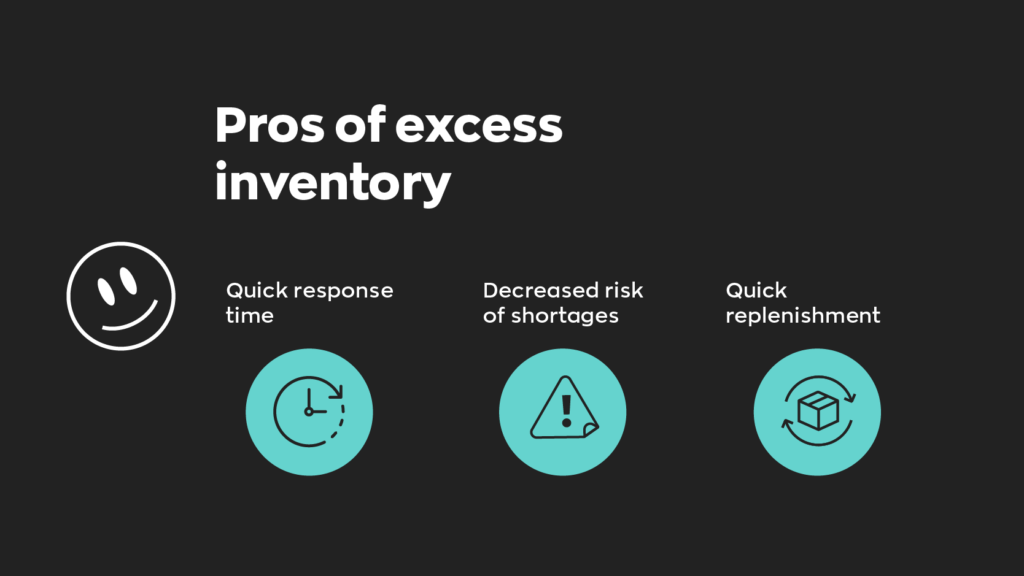
- Some pros of excess inventory are quicker response time, decreased risks of shortages, and quicker replenishment.
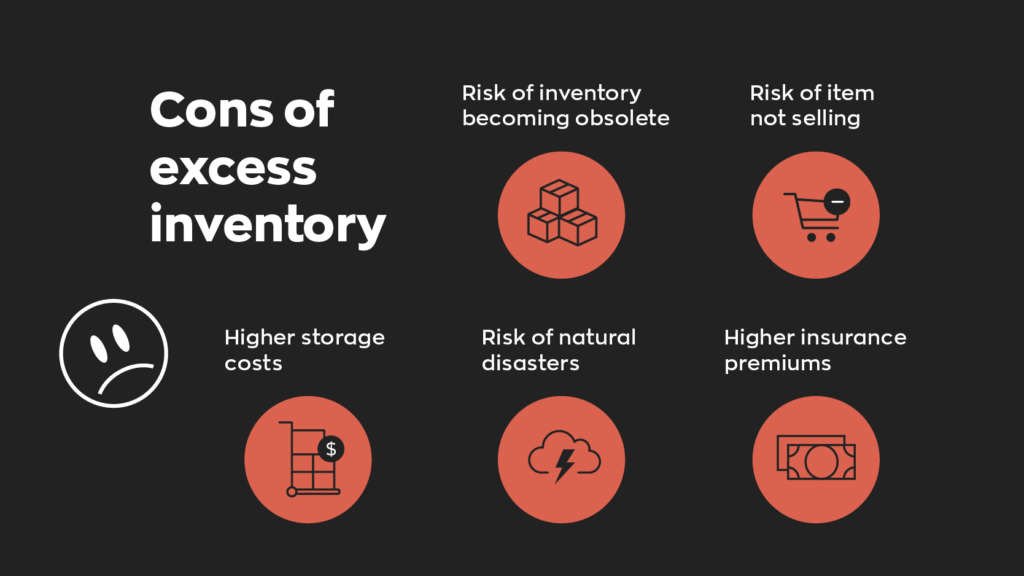
- Some of the cons of excess inventory are tied-up cash flow, risk of obsolescence, and increased storage costs.
- Finding a healthy balance of inventory levels is crucial for businesses to optimize their operations.
With any goods-based business, inventory is the primary source of revenue. So, it’s essential to be smart when holding inventory. It can be tempting to keep excess inventory to ensure you’ll always be able to provide for your customers. But is carrying excess inventory really the best idea? How do you know when you have too much inventory on hand? What happens to excess inventory if you’re unable to sell it?
This article will help you understand the different aspects of inventory control, including some general rules of thumb.
It’s important to note that when we talk about excess inventory, we aren’t talking about safety stock. Since safety stock serves a distinct purpose, it isn’t considered surplus. We have a blog dedicated to safety stock and its relation to reorder points if you want to learn more. Just know that safety stock isn’t considered surplus inventory because it serves a distinct purpose.
So, without further ado, let’s discuss excess inventory!
What is excess inventory?
Excess inventory refers to any inventory that exceeds current or anticipated customer demand. It’s stock that ties up cash without contributing to efficient operations. As a broad, catch-all term, it can include overstock, surplus stock, and even dead stock.
Excess inventory vs safety stock
As mentioned above, excess inventory does not include safety stock. Safety stock is when you deliberately carry too much inventory on hand to protect your business from unknown factors. It’s for those ‘just-in-case’ moments, like unexpected demand or delays from your supplier.
Related terms: overstock, surplus stock, dead stock
In most day-to-day conversations, people use these terms interchangeably, but in inventory management, there are subtle differences that set them apart.
- Overstock is inventory that exceeds expected sales due to overordering, poor forecasting, or slow movement.
- Surplus stock is similar, but a bit less urgent. It’s extra inventory beyond your immediate needs that still has value and can usually be sold or repurposed.
- Dead stock is where things get painful. This is inventory that’s unlikely to sell at all. It’s outdated, obsolete, or simply unwanted, and it often ends up as a loss on your books.
It’s important to know where your inventory sits on the spectrum so you can catch it early, take action, and prevent what could’ve been a quick fix from turning into a write-off.
What causes excess inventory?
Inventory control is all about reaching a delicate balance in your inventory levels. After all, holding inventory for extended periods will eat into your margins. On the other hand, carrying too little could result in stockouts.
Your inventory levels will fluctuate for several reasons, and sometimes, you may find yourself with excess inventory. Don’t worry, it happens to almost every business. The key is understanding why.
Let’s break it down.
Demand-side causes
Sometimes, it’s not about what you ordered; it’s about demand not showing up the way you expected. Some reasons for that could be:
- Poor demand forecasting
- Sudden shifts in customer preferences
- Lower than expected seasonal sales
- Product life cycle changes
Even if your data looks solid, demand doesn’t always behave the way you expect.
Supply-side causes
Sometimes, the root of the problem starts earlier in the supply chain, such as:
- Bulk purchasing to get discounts
- Supplier minimum order requirements
- Logistical delays that lead to over-ordering
Stockouts can be costly, so it’s easy to overcompensate, but those extra units can quickly go from surplus stock to dead stock.
Process & data causes
One of the biggest causes for excess inventory comes from within your company. This is where systems and communication can make or break your inventory accuracy. Some major culprits are:
- Lack of coordination between departments
- Inadequate inventory systems
- Inaccurate or outdated data
Even something as simple as misaligned teams or messy data can quietly lead to excess stock.
With that said, tools like inventory turnover ratio can help you stay on track, but they’re not perfect. You can still end up with surplus inventory.
So, is excess inventory always a bad thing? Not necessarily. Sometimes it can actually work in your favor. Let’s take a closer look at the pros and cons.
Pros of carrying excess inventory
Faster fulfillment & response time
You can quickly fill all customer orders as soon as they arrive. If you can’t ship an order quickly, you’ll lose those valued customers. By keeping excess inventory, you can work to make sure that your shelves are always full. It’ll ensure your store always has a neat and tidy appearance.
Decreased risk of shortages
By keeping stock on hand, you can guarantee that you will always have a particular item. You’ll also have less to worry about if you discontinue a product. If there is a shift in demand for a product, you’ll be able to meet (or even beat) the competition, which means you’ll be able to sell your excess inventory at an excellent price.
Buying advantages
Buying in larger quantities often means lower per-unit costs, reduced shipping costs, and some protection against future price increases. It can even help you build stronger relationships with suppliers. Of course, the benefits only matter if you can sell the inventory reasonably quickly, otherwise those upfront savings can quickly turn into added holding costs.
Cons of carrying excess inventory
Tying up cash flow & increasing carrying costs
When your business is holding inventory, you tie up capital, which will increase your overall carrying costs. This means you’ll have less money to do other things, such as marketing efforts or procuring other products. You’ll also be losing money every day that excess inventory sits, taking up expensive storage space.
Obsolescence, spoilage, and shrinkage
The value and quality of your product decrease the longer you keep it in stock. You have to make it a priority to sell your inventory while it’s new to the market. Smartphones, for example, are updated almost every six months. So, you have to sell your stock before new versions arrive. Otherwise, you might have to sell them at a discount because they are outdated or obsolete.
Similarly, if you sell perishable goods, you’ll need to lower their prices as they approach their expiration dates. Generally, a forced sale is never good and could cause a loss for your business.
Risk of an item not selling
You may have decided to keep excess inventory but then realized you misjudged what will and will not sell. In doing so, you could end up with too much inventory on hand that people don’t want to purchase. Again, you might have to sell at a steep discount or below cost to move the inventory out of your warehouse.
Higher storage costs
Excess inventory means extra storage space. Additional space also means extra costs, and since you have to include those extra costs in your price, you might lose to competition because your price is too high. Even if you have your own warehouse, you would still have extra maintenance costs and risk needing more space for new items. Proper inventory control is all about optimized warehouse space.
Risk of natural disasters
Any type of stock is always at risk of being destroyed or damaged by fires, floods, or other natural disasters. However, having less of it in excess would incur more minor losses should these natural disasters happen.
Higher insurance premiums
The insurance you will pay for items will be directly related to the capital cost of the products you store. The more inventory you keep and the longer you keep it, the more insurance you pay. It’s really that simple!
Is excess inventory worth it?
So, how do you actually decide if holding excess inventory makes sense? It comes down to weighing the trade-offs.
Compare carrying cost vs stockout cost
When considering excess inventory, the simplest approach is to compare the cost of holding inventory with the cost of running out. Carrying costs include storage, insurance, handling, and other expenses associated with holding unsold inventory.
On the flip side, stockouts can mean lost sales, unhappy customers, and missed opportunities. The goal is to find the point where holding a bit more inventory protects you without cutting too far into your margins.
KPIs to watch: inventory turnover, days sales of inventory, forecast accuracy
To keep that balance in check, you’ll want to track a few key metrics. Inventory turnover tells you how quickly products are selling, while days sales of inventory (DSI) is the number of days it takes to sell stock. Forecast accuracy helps you assess how reliable your demand planning really is. Together, these metrics will help you gauge whether you’re overstocking or staying lean.
How to reduce excess inventory (step-by-step)
If you’ve found yourself with excess stock, don’t sweat it; it happens to the best of us. But don’t worry, there are practical ways to get things back under control.
Improve forecasting and reorder points
One of the leading causes of excess inventory is poor forecasting. Start with improving your forecasting first. The more accurate your demand predictions, the less likely you are to overorder. From there, dial in your reorder points so you’re placing orders at the right time, not too early, and not too late.
Improve inventory accuracy and cycle counting
Your forecasting is really only as good as the data you use. This is why you need to make sure your inventory data is reliable. Inaccurate counts can lead to unnecessary purchases and hidden overstock. Regular cycle counting helps you catch discrepancies early and keeps your numbers up to date and accurate.
Clear dead stock responsibly (return, liquidate, donate, recycle)
If the inventory in question has passed the point of no return and has become dead stock, you might return it to suppliers, liquidate it at a discount, donate it, or recycle materials where possible. The goal is to recover value while freeing up space and cash.
Of these options, liquidation typically offers the best recovery on inventory that can no longer move through primary channels. Companies such as Overstock Trader specialize in helping businesses sell excess inventory through secondary markets, allowing you to recover some working capital while freeing up warehouse space.
Software that makes things easier
Of course, doing all of this manually can get overwhelming. That’s where the right tools come in. Warehouse management software can help you track stock levels, set reorder points, and generate purchase orders with ease. For example, tools like inFlow can alert you when inventory runs low and streamline your ordering process. Pair that with barcoding, and you’ll have a much easier time keeping excess inventory under control.
FAQ
What is excess inventory and how does it impact businesses?
Excess inventory is any stock that exceeds your current or anticipated customer demand. It ties up cash, increases storage costs, and raises the risk of products becoming obsolete before they sell. While it can offer some short-term advantages, the financial drag of holding too much stock usually outweighs the benefits.
What causes excess inventory?
The most common causes are poor demand forecasting, sudden shifts in customer preferences, bulk purchasing to hit supplier minimums, and inaccurate inventory data. Often it’s a combination of all of these. The good news is that most causes are preventable with better systems, more accurate data, and tighter coordination between your purchasing and sales teams.
What are the pros and cons of holding excess inventory?
The main pros are faster order fulfillment, reduced risk of stockouts, and potential savings from bulk purchasing. The cons include tied-up cash flow, higher storage and insurance costs, and the risk of products becoming obsolete or unsellable. Whether it’s worth it depends on your industry, product shelf life, and how accurately you can forecast demand.
How can I reduce excess inventory in my supply chain?
Start by improving your demand forecasting and tightening your reorder points so you’re ordering at the right amounts at the right time. From there, run regular cycle counts to keep your inventory data accurate. Inventory management software can also help by automating reorder alerts and giving you real-time visibility into stock levels across your supply chain.
How do I handle excess inventory in retail?
In retail, the most effective approaches are running promotions or markdowns to move slow- or seasonal stock, bundling excess items with faster-selling products, or returning items to suppliers if your agreement allows. For inventory that’s truly become dead stock, liquidation or donation is worth considering. The key is acting early. The longer excess stock sits, the fewer options you have.
How can I sell excess inventory quickly?
Your fastest options are flash sales, bundle deals, or selling through secondary marketplaces and liquidation channels. If you have B2B relationships, offering bulk discounts to other retailers can also move volume quickly. The earlier you identify surplus stock, the more pricing flexibility you have. If you wait too long, it often means selling at a loss.
What software helps manage and prevent excess inventory?
Inventory management software like inFlow gives you real-time stock visibility, automated reorder points, and purchase order tracking, all of which help you avoid overordering in the first place. Pair that with barcode scanning for accurate counts, and you’ll have a much clearer picture of what you actually have on hand versus what you think you have.
The content was very helpful. Keep it up on informing us these things TJ McCue.
Thanks alot
Is helpful to exam
Article Feedback*the article was helpful could gou make one on stock out costs.thank you
Does your company, or one that you are familiar with, ever store excess products? If so, explain why.
Lovely website!!!!
Helped me a lot with my school work!
I hope you guys take over the rubbish wikipedia, they are very bad. You guys are actually amazing, would definitely recommend to everyone. 10/10!!!! 🙂 🙂 🙂 🙂
Love Yassir!
This was a really insightful post! I never realized how excess inventory could be a double-edged sword. It’s interesting to see both the potential cost savings and the risks involved. I particularly appreciated the examples you provided; they really helped to illustrate your points. Looking forward to more posts like this!
Hey Vimeo,
I’m glad to hear you enjoyed the article. We love helping people like you with their inventory troubles 🙂
Cheers,
Jared