 Fellow Canadians: All inFlow plans are available in Canadian dollars





Key takeaways
- Accurate inventory tracking involves batch, serial, and lot number tracking to ensure traceability from manufacturing to sale.
- Lot numbers identify groups of products produced simultaneously with the same materials and are common in industries such as food and pharmaceuticals.
- Not only are lot numbers often required for regulatory purposes, but they also help facilitate targeted recalls, which reduces waste.
- Serial numbers uniquely identify individual units of a product and are essential for warranty services, tracking specific items, and aid in product recalls and service eligibility verification.
- Businesses should record lot and serial numbers upon receipt and during stock transfers.
- Barcodes can be used to streamline the identification of serial and lot numbers to minimize errors.
The importance of lot and serial tracking in inventory
Accurately tracking inventory can require more than just stock counts. Many products have batch, serial, and lot number tracking; properly managing these is just as important as monitoring your inventory levels.
For example, lot and serial numbers can track components from the manufacturing level to the final product’s sale. This traceability is essential in certain industries like food and pharmaceuticals, but other sectors also benefit significantly by using serial and lot number tracking. In this post, we’ll dig through what each of these numbers represents and how you can effectively track them.
Are you more interested in a quick video overview instead? Well, you’re in luck! Watch this short clip from our new podcast.
Batch and lot number tracking: ensuring traceability & compliance
Tracking batch and lot numbers is critical for maintaining quality control and traceability across your supply chain. They help streamline recalls and audits while also supporting compliance with industry regulations and customer safety standards.
What are batch and lot numbers?
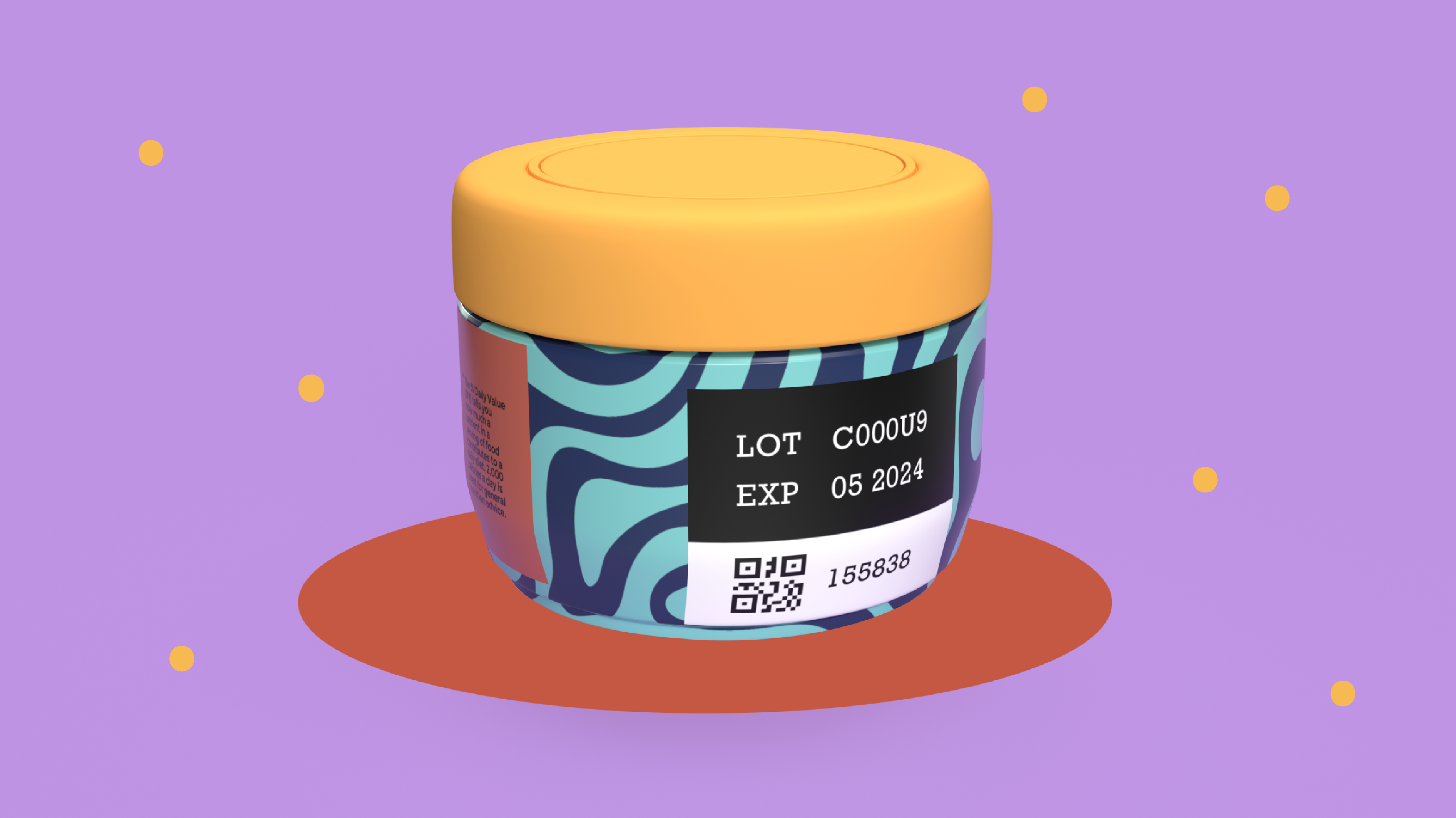
The terms batch number, code number, and lot number are interchangeable, so we’ll use lot number for simplicity going forward. What is a lot number? A lot number identifies a group of products that were all produced at the same time using the same batch of ingredients or raw materials. You’ll find lot numbers commonly used in the food and pharmaceutical industries. They can also help track children’s products.
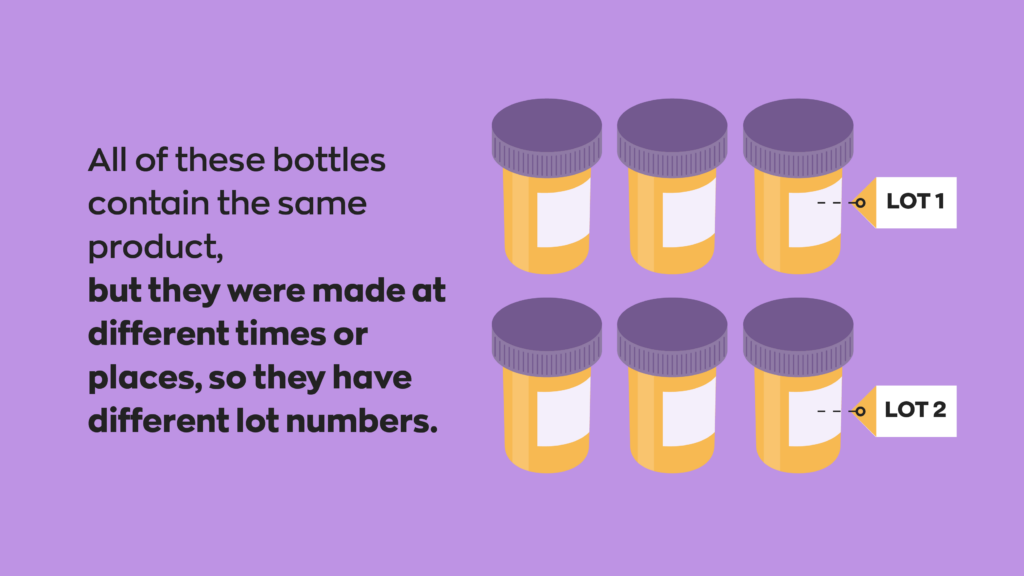
Lot number tracking can save manufacturers a lot of money and effort. If a product has a problem, you can recall specific lot numbers. For example, a pharmaceutical company discovers a dangerous ingredient in one of its drugs. Rather than disposing of everything on their shelves, they can use lot number tracking to target a recall of the affected products.
Are you having an issue with a product? You’ll likely report it to a manufacturer using lot number tracking. Sometimes, manufacturers give lot numbers a prefix (e.g., Lot 114321). Other times, they might stamp or print them on the product.
Benefits of lot number tracking (traceability & compliance)
Some of the most common benefits of lot number tracking for manufacturers include:
- Comply with regulatory standards: If you manufacture perishables, food products, or pharmaceuticals, lot number tracking may be a legal requirement.
- Improve customer satisfaction: Lot number tracking means you can more quickly identify and respond to any potentially defective, damaged, or dangerous products.
- Reduce waste: When you issue a recall, you can pinpoint specific batches of products, eliminating the need to purge everything you have on hand. This can drastically improve your margins.
- Better product forecasting: By using data in lot numbers, such as when you produce certain items and how many are available, you can create accurate customer demand forecasts.
- Clear communication: Utilizing lot number tracking will ensure everyone across all departments has a clear line of sight into the production process.
Best practices for lot tracking
No matter how you start lot number tracking, there are some best practices to follow when tracking lot numbers in inventory:
- Use specific lot numbers when fulfilling orders to maintain traceability and prevent product mix-ups.
- Using a barcode system for lot number tracking helps streamline data entry and ensures fast, accurate identification during receiving, transfers, and picking.
- Implement inventory management software that supports lot and serial tracking to centralize records and minimize errors.
How to start tracking products by lot number
If you’re wondering how to track lot numbers in inventory, the process is fairly straightforward. Here’s a step-by-step method you can follow.
- Step 1 – Record lot numbers at receiving: Log the lot number and quantity for each product batch on the corresponding purchase order as goods arrive. Recording lot numbers on purchase orders is critical for maintaining traceability from the start.
- Step 2 – Store units by lot number: Group and store items with the same lot number in a single, clearly designated location to simplify traceability.
- Step 3 – Use your inventory system’s lot field: If your software supports it, enter the lot number in the dedicated field. For example, inFlow users now have the ability to easily track lot numbers & expiration dates.
- Step 4 – Track lot numbers on pick lists: Even if you don’t include them on customer invoices, always include the lot number on your internal pick lists for accurate fulfillment and recall tracking.
- Step 5 – Use pick list data for returns and defect tracing: When handling returns, refer to the pick list to identify the lot number tied to any defective product and trace issues back to the source.
Serial number tracking: managing individual units
Serial number tracking is the process of monitoring each individual product throughout its entire lifecycle, making it essential for high-value goods, warranty management, and fraud prevention.
What is a serial number?
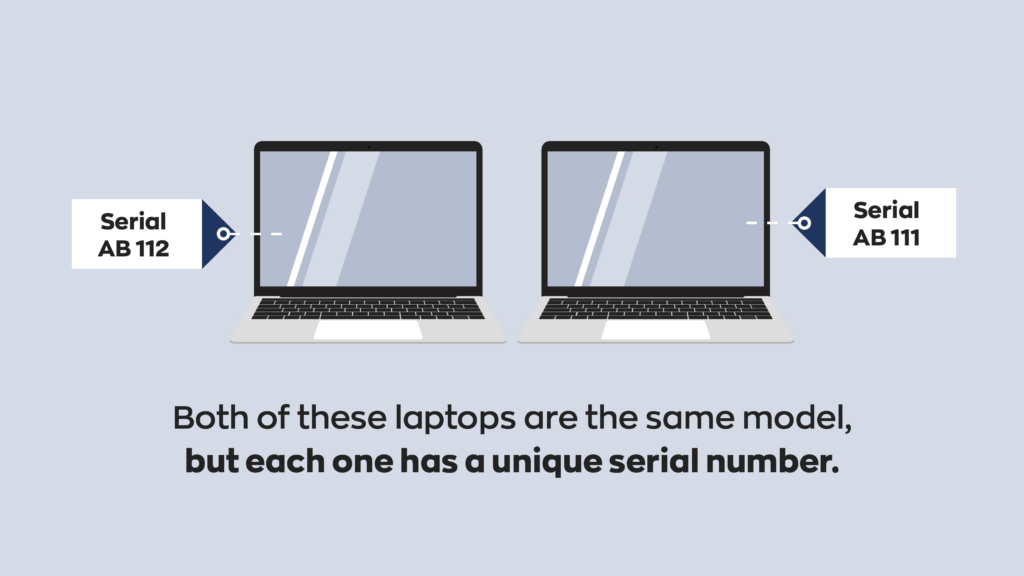
When it comes to lot numbers vs serial numbers, both serve a similar purpose. Unlike lot numbers, which apply to groups of products, serial numbers identify individual units. In other words, they’re even more specific than batch or lot numbers. Manufacturers could give the same lot number to tens, hundreds, or even thousands of identical products. On the other hand, you would only assign one serial number per unit. In other words, serial numbers make products unique, so you can differentiate one unit from another.
If you look at the bottom of a laptop, you’ll likely find a serial number printed or engraved on it. If you don’t see it there, the number is often associated with your purchasing account. The retailer will print the serial number on the original invoice in this case.
You can use serial numbers for recalls, but they’re also handy for service eligibility. For example, warranty and repair services often require you to provide the manufacturer with a serial number. Additionally, invoices that include the serial number will help identify the date of purchase.
Serial numbers can also contain more information about the product. The encoding can vary from company to company, but you can commonly use a product’s serial number to identify its model number, date of manufacture, and even manufacture location.
How to track serial numbers in inventory
If you’re learning how to track serial numbers in inventory, the process starts the moment products arrive. When you receive goods, record both the quantity and the unique serial number assigned to each individual unit. Continue tracking those serials through all product movements. This includes all external movements, such as sales or customer returns, as well as any stock transfers between other warehouses. The goal is to maintain an unbroken chain of visibility for every unit from purchase to sale.
Tips for effective serial number tracking
If you sell serialized products, you’ll need an extra level of precision in your inventory tracking. Here are some tips you can follow:
- Use barcode scanners: Scannable serial barcodes speed up data entry and reduce human error during transfers and transactions.
- Avoid manual spreadsheets: While spreadsheets may work for small volumes, they’re prone to input errors and overwrites. As product lines grow, manual systems become inefficient and risky.
- Automate wherever possible: Use tools that prompt for serial input at each stage of your process. This includes receiving, transferring, picking, or selling. This will help prevent gaps in tracking.
Using inventory management software for lot & serial tracking
Inventory software for lot and serial number tracking simplifies the process by tying these identifiers directly to product records, transactions, and locations. For example, inFlow Inventory ensures serial numbers are recorded consistently across all movements, from receiving through to final sale. Features like barcode scanning, automated pick lists, and transaction history eliminate the need for precarious spreadsheets. If you’re looking to streamline your tracking process and gain better control over serialized products, an integrated system like inFlow can make all the difference.
Conclusion: achieving full traceability
Whether you manage high-volume batches or serialized units, accurate tracking is essential for quality assurance, recalls, and compliance. Implementing some best practices alongside the right tools will ensure you can trace every item from production to the end of its lifecycle. Lot and serial number tracking isn’t just a safeguard; it’s a competitive advantage.
FAQ
What is the difference between lot numbers and serial numbers?
Lot numbers identify groups of products manufactured together using the same materials and processes, while serial numbers uniquely identify individual units.
Why do businesses need to track lot and serial numbers?
Lot and serial number tracking helps businesses comply with regulatory requirements, facilitate targeted product recalls, provide warranty services, and maintain quality control.
Can small businesses afford lot and serial number tracking?
Yes, many inventory management software solutions offer affordable lot and serial tracking features designed for small businesses. The cost is often offset by reduced waste during recalls, improved customer service, and better regulatory compliance.
Can serial number tracking software integrate with existing ERP systems?
Yes, most modern serial number tracking software offers ERP integration through APIs or direct connections. This integration allows seamless data flow between your inventory management, accounting, and production systems, eliminating duplicate data entry and ensuring consistent tracking across all business operations.
Which industries benefit most from global batch traceability solutions?
Food and beverage, pharmaceuticals, automotive, aerospace, and medical device industries benefit most from global batch traceability. These sectors face strict regulatory requirements, safety concerns, and the need for rapid recall capabilities across international supply chains and distribution networks.
What are the key features to look for in lot, batch, and serial tracking software?
Look for barcode scanning, expiration date tracking, reporting features, and seamless integration with existing systems. The software should also offer real-time inventory visibility, dedicated lot, batch, and serial tracking fields.
How do lot, batch, and serial tracking systems improve inventory management?
These systems provide complete visibility into product movement, enable FIFO/FEFO rotation, reduce carrying costs through better demand forecasting, and minimize waste during recalls. They also improve customer service by providing detailed product history and supporting warranty claims with accurate purchase and manufacturing data.
The article is nice but does not tell me how to do that in Inflow. This is what I need to track inventory with a lot number then stored by shipper 1 2 3 4 5 with multiple serialized units 32 34 35 ….
Hi Sophie!
good question. inFlow doesn’t have a field called named lot numbers, but we do have sublocations: https://www.inflowinventory.com/support/cloud/how-do-i-track-lot-numbersbatch-numbersexpiration-dates/
Those sublocations could then be named after shippers or lot numbers.
Within each sublocation, you can store serialized products as long as you’re using our Advanced/Enterprise plan on Cloud: https://www.inflowinventory.com/support/cloud/can-i-track-products-with-serial-numbers-using-inflow/
So as a final example, you could have a Location (Warehouse A), Sublocation (Lot 45), and have products in that lot also support unique serial numbers.
I hope that helps, and our support team would be happy to help with any other questions that might pop up. The easiest place to find them is here: https://www.inflowinventory.com/software-contact-info
I’d like to know a bit more about this product? Can you use warehouses as a different feature to say equipment is in storeroom, has been moved to staging and now it’s couriered to customer and finally closed Inventory?
I’m trying to find something that can help with managing the tracking stages of customer equipment from when it is delivered to us through the stages and then received/closed by customer. Ideally I would require fields that are associated to PO or/and SO’s. Part number, serial number, customer name etc.
Hi Robyn,
Thanks for getting in touch!
The quick answer is that inFlow can handle workflows where you just need to keep track of local inventory, and it can also help you record the process of sending products to customers and properly removing them from inventory. The thing we do not currently track is when the products are received by the customers; currently they would have to tell you that themselves or you’d have to check based on tracking numbers.
Since you left your email address with us, I’ve forwarded your questions to our support team and they’ll be in touch via email with followup!
What is this the serial number of?
JxNRCV200703117
Sorry Caleb, serial numbers are pretty specialized with prefixes and suffixes, so without having more context like the manufacturer and type of product, it’s not usually possible to tell from the serial number alone what product it would belong to. Sorry we can’t help more here!
How can I trace a serial number to a camcorder to see if it was stolen
Hi Renee,
If it was a camera sold at your store, then you’d be able to investigate and see if that serial number was ever on any sales orders (if it wasn’t, then it may have been stolen).
hi! is it possible to create a lot number with serial number? if possible, how? for breads and cakes having 2 or more commissary. hope to here from you the soonest. thank you!
Hi Averie,
Our software doesn’t currently explicitly support lot numbers, but we do offer a workaround where you use a sublocation to represent lot numbers.
So you could create a serialized product in inFlow and then store it in a sublocation that reflects its lot number.
We manufacture architectural stone veneer.
We sell the stone “per square foot”. But it’s packaged on individual pallets. One pallet might have 150 sq ft…..the next pallet might be 200 sq ft of same stone. All inventory eventually leaves the warehouse on a pallet.At any given time there might be 100 pallets of stone in the warehouse with different quantities of stone…
My question: Would giving each pallet a serialized number be my best option?
Hi Tommy, yes, serializing each pallet could work. We also support prefixes for serial numbers, so you could have different prefixes to denote different sizes of pallet.
The other way to work around this would be to make a sublocation out of each pallet and receive pallets to their own unique sublocations.
We are just starting our business of manufacturing of metal parts, wherein we have to record the certificates of each metal used. I am having trouble giving a unique identifier to the Lot Number to be used to trace the parts made from the metal supplied from each supplier. Could the lot number be the same as the Sales Order from the supplier only with “LTN” in front of it, and the part number of the product following, with the storage location following that, as example (Warehouse ) WH1. Then when a part is made from this metal, should that lot number be on our sales order to the customer? Having a problem (in my head ) as to how to marry up all the numbers ( SO, PO, WO and Lot number ) and easily trace them all back to the original order. Thank you for your input!
Hi Jan,
Hrmm, this might be better as a support ticket with our team, but I’ll give it a quick try in comments.
Assuming you’re using inFlow, if you’re trying to keep a consistent lot number, you could try using a sublocation to represent the lot numbers and the locations to represent the warehouse as a whole. If your supplier doesn’t provide a lot number, I think your idea of basing it on a PO or SO number works, since those must be unique in inFlow (no duplicates).
So if you bought metal from a supplier on PO-0001 and you stored it in WH1, the location would be WH1 and the sublocation would be called PO-0001.
When you use that metal on a work order in inFlow, the Pick tab in your work order would serve as a permanent record of which lots were sourced in the work order.
The Put Away tab of the work order could also use that same PO-0001 sublocation.
This would mean that raw materials and finished materials would both occupy that PO-0001 sublocation, but if the items have very different names and descriptions, that could be OK.
The idea would be that the location represents the raw materials from that lot number, and final products made from that lot.
When you sell that metal, you’d pick from the PO-0001 sublocation and that would also be permanently recorded in inFlow.
If you needed to, you could print out the pick list and crop it to show the customer where those products were taken from. That would basically show the lots to them. It wouldn’t be on the invoice, but it could be a document accompanying the invoice — all generated by inFlow.
I hope that helps with some direction. If you have other questions, you can reach us through our support channels (support@inflowinventory.com) and live chat on http://www.inflowinventory.com.
– Thomas
You describe LOT numbers, but without a single information on where to find it in the Dear system. And I cannot find it in the system neither, why? Because it doesn’t exist. You are describing a feature (that is like a basic feature for inventory management) and then you only add an sentence “inflow doesn’t offer it, but a workaround”. Such a waste of my time, both for reading this article and for trying inflow.
Sorry we disappointed you, Grzegorz. This article is mostly about how people go about tracking lot and serial numbers—a kind of general overview. But we do mention that inFlow can help with these use cases, too. (We don’t mention Dear Systems because that’s not our software.)
However, since we wrote this article a few years ago we have added new features that improve lot number tracking within inFlow.
It was a workaround before, but you can now use sublocations in inFlow to represent lot numbers. There’s a setting in Cloud to help you automatically pick products based on lot numbers. If you’d like any help trying out this feature, please get in touch with support@inflowinventory.com and we’d be happy to assist.
How can I check a Lot on a product I ordered previously?
Hey Luis,
If the product you ordered has a lot number it will more than likely be located on the product label. Different products and companies will list these differently so you’ll need to look up the product in question to find out whether the lot number can be located. I hope this helps,
Cheers,
Jared
I have a Scott Teton circa 1990’s Model 4130 Chromoly #F30E4980 and trying to figure its today value. I’ve had this bike in my shed for 23 years and need to sell it. My sister was given this bike about 1990 or a little before, just hoping to get a value on it.
Steve
I need a replacement window but I only have the window serial number. Can I find the manufacture with the serial number?
Hey Camille,
That’s a tricky one. A lot of manufacturers will have serial number databases where you can perform a quick lookup, however if you’re not sure which manufacturer made the window it would be hard to find which data base to search. My advice would be to put the serial number into a search engine along with the term “window” and see if anything comes up. Alternatively you might try searching some of the most popular window manufacturers in your region and perform a lookup in their serial number database. I hope this helps, good luck!
Cheers,
Jared
CAN YOU TELL ME ABOUT MY TAYLOR 614 GUITAR SERIAL NUMBER 1108`100070
THANK yOU
Hey David,
Here is some information I found on your guitar according to the information on Taylors website. Your guitar was made on August 10, 2010 in El Cajon, California. I hope this helps.
Cheers,
Jared
My B C Rich electric guitar serial number is 64101450 I’m being told it doesn’t exist
Hey Tony,
Thanks for reading. As far as your serial number coming up as non existent, there are a few things that could be at play. One might be the database your searching is incomplete and doesn’t have every official serial number listed. Another may be the your guitar is not authentic and is actually counterfeit. I would try and contact the manufacturer directly and see if they can help you find more answers.
Cheers,
Jared
I was inherited a Ranch Fiberglass Cover when my brother passed away in the middle of December an I was wondering just what type of truck it fits?
The Serial # is
101216-29
Hey Billy,
Thanks for reading. Unfortunately, we can’t help you there. You’re best bet would be to reach out to Ranch directly and see if they can look up the serial number for you. I hope this helps.
Cheers,
Jared
Have a HON 4 DRAWER FILEING CABINET. NEED SLID RAILS FOR 1 DRAWER.
SERIAL # IS C5AYY4.
CAN YOU GIVE ME PRODUCT # FOR THE RAILS.
Hey Douglass,
Thanks for reading. Unfortunately I can’t help you with that. You’ll have to contact the manufacturer directly.
Cheers,
Jared
I need serial number of 1 voucher pin 1661453210117170
Hey Neliswa,
Thanks for stopping by. In regards to your request, I can’t really help you. You’ll need to contact the manufacturer or the product you need the serial number for. I hope this helps.
Cheers,
Jared
I have a combine harvester I need to know the exact age of it
Hey Mamdo,
You’ll need to contact the manufacturer directly. They should be able to help you identify the exact age of your product, provided you locate a serial number. I hope this helps.
Cheers,
Jared
R37T2SQ4KH3SEB
Is my travel adapter authentic?
Hey Jamal,
You’ll have to reach out to the manufacturer of the travel adapter to find out. You could also check an online directory if the manufacturer has one.
Good luck,
Jared
My charger got mixed up with others . So i wanna check the originality and manufacturing date and if they’ve come in ipad box or not. HHY320423UJ1PW9AT
Hey Rozhina,
To check your serial number you’ll have to go directly to the manufacturer. Many companies have online directories where you can look up your item, but otherwise, you may have to reach out for more information.
Cheers,
Jared
I want check my HP laptop warranty status .Serial No is CND233285V.
Thank You
Hi Abhishek,
Thanks for reading. You’ll have to contact the manufacturer directly to enquire about serial numbers. I’m sorry we couldn’t be of more help.
Cheers,
Jared