 Fellow Canadians: All inFlow plans are available in Canadian dollars





Key takeaways
- The best order picking method for a small warehouse is usually single order picking, because it’s simple, quick to train, and has the lowest error risk at low order volumes.
- Order picking can account for as much as 55% of a warehouse’s total operating expense, which makes it the single biggest lever for cutting warehouse costs.
- The five main order picking methods are single (discrete) picking, batch picking, cluster picking, zone picking, and wave picking. Many warehouses combine them into hybrids such as zone-batch or zone-wave picking.
- The right picking method depends on daily order volume, items per order, SKU count, warehouse size and layout, team size, product type, and shipping deadlines.
- Roughly 50% of a picker’s time is spent traveling, so layout changes like street-style routing and placing fast-moving SKUs near packing often improve efficiency more than switching methods.
- Best-in-class warehouses pick orders with at least 99.68% accuracy, while most small and mid-sized operations self-report 95% to 98%.
- Goods-to-person (GTP) systems bring stock to a stationary picker, cutting travel time and allowing vertical storage, but they require significant investment and suit high-volume facilities.
If orders are going out the door on time, your picking process is working fine, right? Perhaps. But “working” and “working well” can be very different things, especially when picking quietly eats up more of your warehouse budget than any other task.
The good news is that small and medium-sized warehouses can achieve the same cost savings and productivity gains as the big players. It mostly comes down to choosing the right picking method for your operation and setting up your space to support it. In this guide, we’ll walk through every major order picking method, how to choose between them, and the layout, training, and software changes that make any method work better.
What is order picking?
Order picking is the process of collecting items from storage to fulfill a customer order. A picker receives a list of what’s needed, finds each item in the warehouse, and brings it to a packing or shipping area.
Two terms come up constantly here, and they’re easy to mix up:
- Pick order: the instruction (paper or digital) that tells warehouse staff which items to pick, where to find them, and how many to collect for a customer order.
- Pick list: the document or digital checklist pickers actually carry through the warehouse to carry out that pick order.
Your order picking method is the system that decides how those orders are grouped, who picks them, and in what sequence. That’s what we’ll be comparing below.
Why does your order picking method matter?
Your picking method matters because order picking is usually the most expensive and labor-intensive job in the warehouse. According to a widely cited literature review by de Koster, Le-Duc and Roodbergen (2007), picking can account for as much as 55% of total warehouse operating expense.
When you’re not based in the warehouse on a day-to-day basis, it can be challenging to spot where that money goes. Our State of Inventory Management 2026 survey of 400 operations professionals shows it’s a common blind spot:
- 61% named labor productivity as their top warehouse challenge, and 49.8% named order accuracy.
- 54.5% run at 95% to 98% order accuracy, and only 16.2% reach 99% to 100%.
- 38.5% take three to five days to fulfill an order once it’s placed.
That accuracy gap adds up faster than you’d think. At 10,000 orders a year, the difference between 98% and 99% accuracy is 100 extra mistakes, each one a return to process and a customer who might not come back.
The right picking method can also make employees’ jobs easier. An inefficient system that sees warehouse staff darting back and forth won’t lead to the best results or happy staff members.
What are the main order picking methods?
The five main order picking methods are single order picking, batch picking, cluster picking, zone picking, and wave picking. Each one groups orders differently, which changes how far pickers walk, how many people touch an order, and how much sorting happens afterward.
There’s no one-size-fits-all approach. These methods vary in complexity and efficiency, so it’s important to match the method to the size of your operation and its needs.
Single order picking
Single order picking (also called discrete picking) is where one person picks every item for one order before starting the next. The employee completes the order by moving around the warehouse with a pick list.
It’s often considered the best order picking system for a small warehouse due to its simplicity, shorter training times, and quick implementation. In single order picking, employees may use barcodes that are linked to a warehouse management system (WMS) to improve accuracy and efficiency.
- Best for: low order volumes, small teams, and smaller warehouses
- Advantages: easy to learn, highest accuracy, no sorting step
- Drawbacks: the most walking per order, so it slows down as volume grows
Batch picking
In batch picking, the employee works on several orders at once. These batches often combine orders with items that are found close together in the warehouse. As a result, the number of trips a picker needs to make is reduced. Once the batch has been picked, the items are then sorted into the relevant orders.
Batch picking works well when orders contain similar items and when these items are relatively small in size. That way an employee can more easily pick and transport multiple items in one trip.
- Best for: high volumes of small orders with overlapping SKUs
- Advantages: far less travel per order
- Drawbacks: adds a sorting step afterward, which is where mix-ups can creep in
Cluster picking
Cluster picking is a variation of batch picking where the picker sorts items into separate bins or totes, one per order, while picking. A cart might carry six or eight totes, and each item goes straight into the right one.
- Best for: ecommerce and other operations with many small, single-line or few-line orders
- Advantages: batch-level travel savings without a separate sorting step
- Drawbacks: needs carts or totes, and pickers must place each item in the correct tote
Zone picking
As the name suggests, this method involves dividing the warehouse into specific zones. Each employee works within their own zone, meaning that the order moves around the warehouse, but the person does not. When an order passes from one zone to the next, it’s sometimes called pick-and-pass.
For large orders, zone picking can limit the distance each employee travels, saving time and energy. Employees will also get to know their zone, which may help reduce confusion and mistakes.
- Best for: larger warehouses, larger teams, and orders with many lines
- Advantages: less walking, and pickers become experts in their zone
- Drawbacks: there could be delays with order packing as employees wait for items to be collated from different zones
Wave picking
With wave picking, sets of orders are released throughout the day in “waves.” The aim is to ensure a consistent flow based on shipping priority, order type, and/or workforce levels. Orders are packed once all items in that wave are picked.
- Best for: warehouses that regularly deal with high volumes of orders and fixed carrier pickup times
- Advantages: keeps picking in step with shipping schedules and staffing levels
- Drawbacks: orders may not be picked and packed straightaway, slowing down some order fulfillment times
Hybrid picking methods
Many warehouses don’t use just one method. Hybrid methods combine the strengths of two:
- Zone-batch picking: each picker batches orders, but only within their own zone.
- Zone-wave picking: orders are released in waves, and each zone picks its part of the wave at the same time.
Hybrids add coordination work, so they tend to make sense once a single method starts hitting its limits.
Order picking methods compared
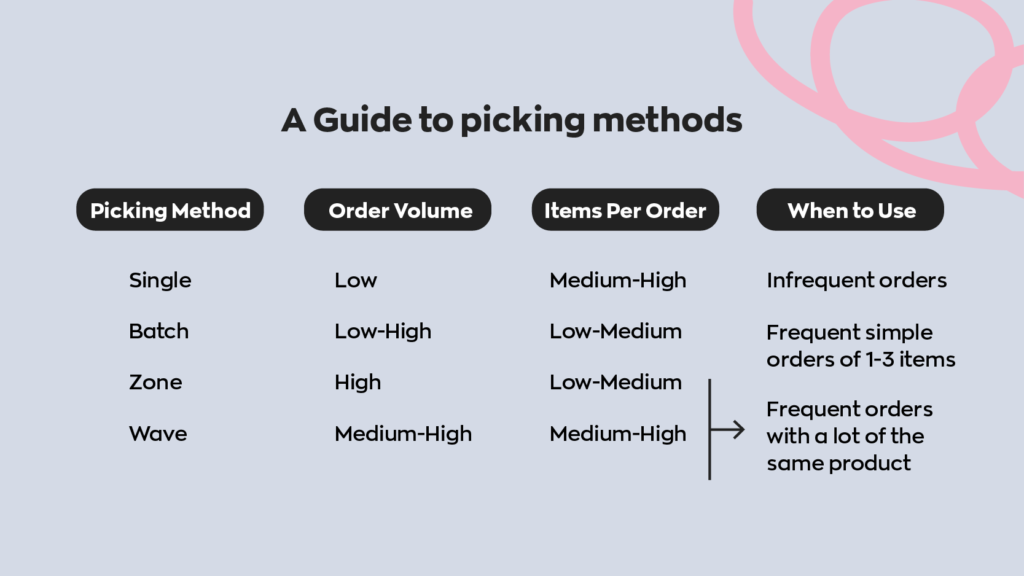
| Method | How orders are grouped | Best for | Main advantage | Main drawback |
|---|---|---|---|---|
| Single order picking | One picker, one order at a time | Low volume, small teams | Simple and accurate | Most walking per order |
| Batch picking | One picker, several orders, sorted after | Many small orders with shared SKUs | Fewer trips | Extra sorting step |
| Cluster picking | One picker, several orders, sorted into totes during the pick | Many small orders | Fewer trips, no separate sort | Needs carts and totes |
| Zone picking | Each picker owns a zone; orders move between zones | Large warehouses, large orders | Less walking per person | Consolidation delays |
| Wave picking | Orders released in scheduled waves | High volume, fixed ship times | Matches shipping and staffing | Some orders wait for their wave |
How do you choose the right order picking method?
To choose the right order picking method, start by measuring your daily order volume, items per order, and warehouse size, then match those numbers to the method built for them. For most small warehouses, that means starting with single order picking and moving to batch, cluster, zone, or wave picking as volume grows.
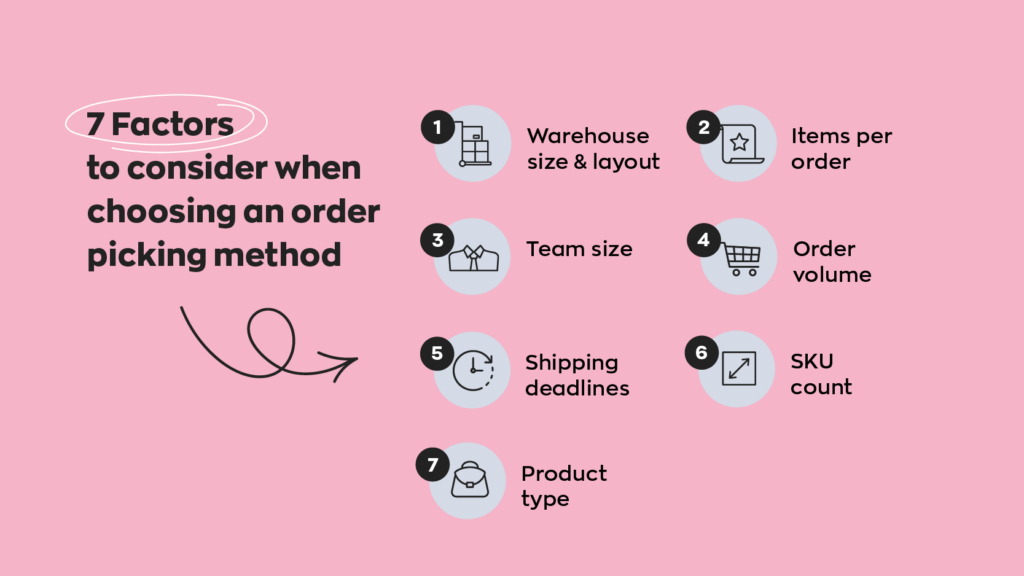
The best warehouse picking method for a small business depends on factors like space limitations, a smaller workforce, inventory type, and more. Because of this, you might choose a different method than your competitors or partners. But even as the processes change, the aims remain the same. The right picking method will include, amongst other elements:
- Fast routes
- Well-planned processes
- Minimized room for errors
- High levels of safety
Step 1: Measure your order volume and order profile
Count how many orders you ship on an average day and on your busiest day, then look at how many lines (different SKUs) a typical order contains. Low volume points toward single order picking. Lots of small orders with overlapping items point toward batch or cluster picking. Big orders with many lines point toward zone picking.
Step 2: Map your warehouse size and layout
The bigger the building, the more walking each method costs. In a small stockroom, single order picking barely loses anything to travel. Across a large warehouse, splitting the space into zones or batching orders can save hours a day.
Step 3: Look at your team size
Zone picking needs enough people to staff every zone at once. If you have two or three pickers, single, batch, or cluster picking will usually be a better fit. Larger teams can support zones and waves.
Step 4: Review your SKU count and product types
Small, lightweight items that fit in a tote suit batch and cluster picking. Bulky, heavy, or awkward items are harder to carry for several orders at once, which favors single or zone picking. Products with lot numbers, serial numbers, or expiry dates add a verification step to every pick, so accuracy matters even more.
Step 5: Factor in shipping deadlines
If carriers pick up at fixed times, wave picking helps you release the right orders at the right moment. If you ship continuously or promise same-day dispatch, waiting for a wave can slow you down.
Quick reference: which method fits your warehouse?
| If your warehouse has… | Start with |
|---|---|
| Low order volume and a small team | Single order picking |
| Many small orders with overlapping SKUs | Batch picking |
| Many small, single-line or few-line orders (common in ecommerce) | Cluster picking |
| A large building and orders with many lines | Zone picking |
| High volume and fixed carrier pickup times | Wave picking |
| High volume in a large building with a big team | A hybrid, such as zone-batch or zone-wave |
Remember, there’s no universal “best” picking method. What works for one warehouse might actually slow another one down. Revisit this decision as your volume and team change.
How can you make order picking more efficient?
The fastest way to make order picking more efficient is to cut travel time, because walking takes up about half of a picker’s day. Boosting efficiency is about working smarter, not faster, and most of these improvements are easy to implement, even with a limited staff.
| Picker activity | Share of picking time |
|---|---|
| Travel | 50% |
| Search | 20% |
| Extract (the pick itself) | 15% |
| Setup | 10% |
| Other | 5% |
Source: typical picker time distribution from Tompkins et al., Facilities Planning, as presented in Georgia Tech’s Logistics Systems Design course notes.
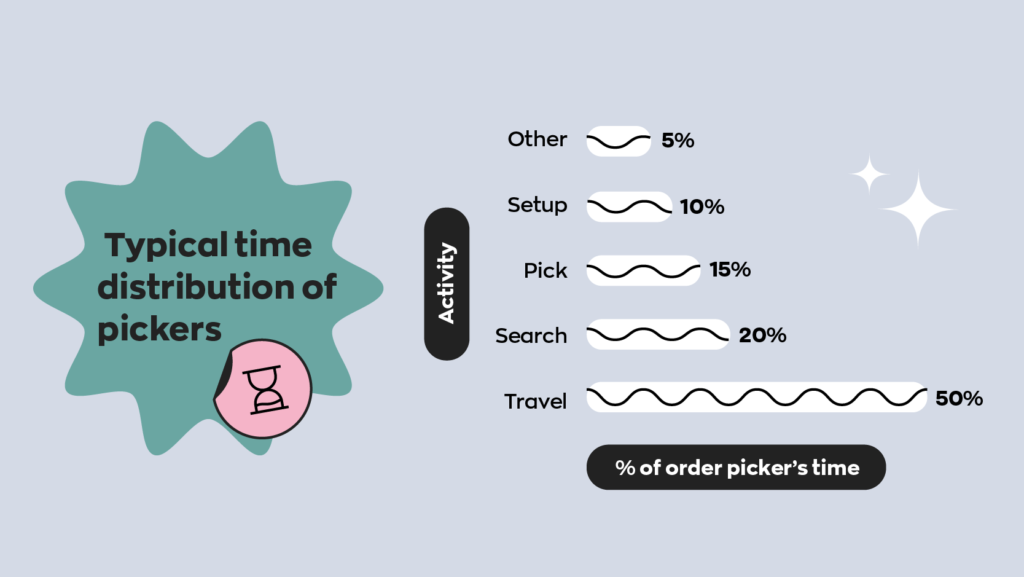
Small changes to your layout, training, and inventory placement can shave minutes off each pick, minutes that quickly add up to hours. In a simulation study, Dukic and Oluic found that the right combination of routing, storage, and batching methods could reduce picker travel distances by up to 80%.
Use a street-style warehouse layout
Research suggests that 50% of total order-picking time is spent on traveling. So, when a single employee is responsible for picking all, or a large part of, an order, it’s especially important to optimize the route they take. Creating a good layout is an important place to start.
Street-style layouts are an example of warehouse best practice. Here, you would organize your aisles like streets. Each aisle is labeled with a marker (for example, a letter of the alphabet), which works like a street name. That aisle is divided into sections and labeled in a pattern that mimics the house number system on streets in areas like North America or the UK.
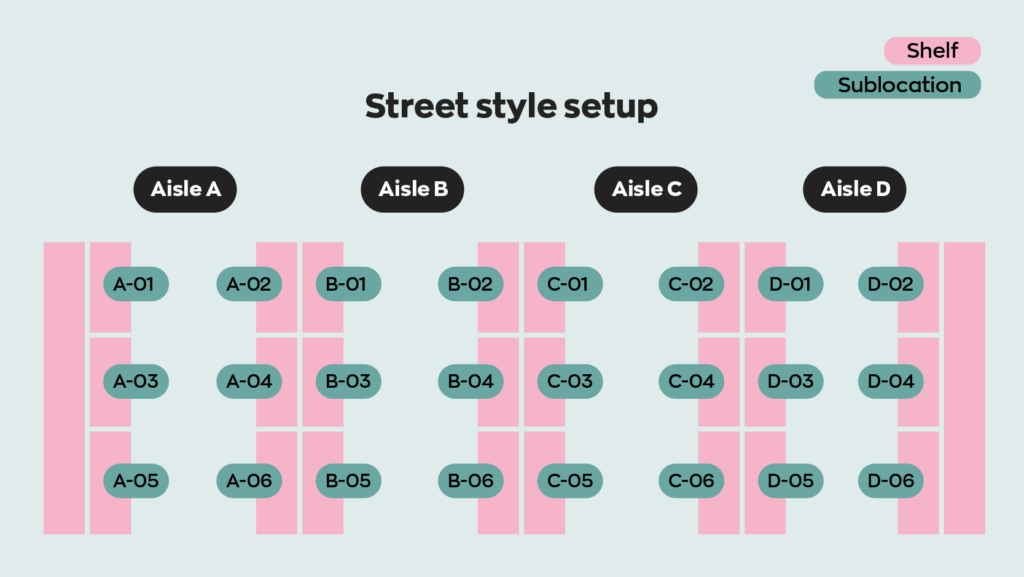
Street-style layouts rank among the top best practices for minimizing unnecessary travel in the aisles. You can find in-depth information in our guide to implementing street-style routing in your warehouse.
Place fast-moving SKUs closest to packing
Your fastest-moving products shouldn’t be hidden in the back of your warehouse. Place your most commonly picked SKUs near packing stations and on easy-to-reach shelves. This will drastically cut down travel time and boost pick rates, especially in high-volume environments. Think of it as creating a “fast lane” for your most popular items.
Keep shelves organized and clearly labeled
Even the best possible system for your business won’t be effective without good warehouse organization. A clean, well-organized warehouse makes it easier for pickers to find what they need quickly and safely, which directly cuts that 20% of time spent searching. Clear labels on products and shelves, consistent warehouse slotting, and routine maintenance go a long way.
Train pickers regularly
The best picking system in the world won’t do you any good if your team doesn’t know how to use it. That’s why training is just as important as the process itself, and it’s not just a one-and-done task. New employees need thorough onboarding, and long-time staff benefit from regular refreshers to stay sharp and consistent.
One pattern we see in inFlow’s own support conversations: mis-picks often happen on lookalike items (say, the same product in two weights) when pickers tap a checkbox instead of scanning. If you carry similar-looking SKUs, make “scan every pick” part of your training.
Review performance on a schedule
Once you have a system in place, the hard part is over. But the work doesn’t stop there. Set aside time to analyze key metrics and gather feedback from your team. Have pick times improved? Are errors decreasing? This way, you can identify what’s working, catch problems early, and make smart adjustments as needed.
How do you measure order picking performance?
You measure order picking performance with four core metrics: picking accuracy, pick rate, order cycle time, and cost per order picked. Tracking them over time tells you whether a new method or layout change is actually working.
| Metric | How to calculate it | Best-in-class benchmark |
|---|---|---|
| Picking accuracy | Orders picked correctly ÷ total orders picked × 100 | 99.68% or higher |
| Pick rate | Order lines picked (and shipped) ÷ labor hours | 70 lines per person per hour |
| Order cycle time | Time from order received to order shipped | Hours, not days |
| Cost per order picked | Total picking labor cost ÷ orders picked | Track against your own trend |
Benchmarks: WERC 2025 DC Measures report, as summarized by Yale Materials Handling. “Best in class” means the top 20% of warehouses surveyed.
Many operators already watch at least part of this list. In our State of Inventory Management 2026 survey, 68.2% track order accuracy and 56.2% track order cycle time. Pair those with your inventory accuracy, since pickers can’t pick what your records say is there but isn’t.
What is goods-to-person picking?
Goods-to-person (GTP) picking is a system where items are brought to a stationary picker, rather than the picker walking to the items. Traditional order picking methods are person-to-goods (PTG). This works as it sounds: the employee travels to where the item is. However, this can take up time and energy, decreasing efficiency. In large fulfillment centers, pickers have been reported walking around 18 km (about 11 miles) per shift.
As technology develops, so do the possibilities for implementing GTP methods. For example, employees might be based at workstations, receiving items that are delivered to them via a conveyor belt, carousel, or mobile robot.
Using GTP order picking methods can help large facilities reduce traveling time and also allow for vertical storage options, making use of otherwise empty space that employees would struggle to reach. However, GTP solutions can be expensive to implement, and so the benefits need to outweigh the costs for any business considering transitioning to these methods. The same MDPI study notes that collaborative picking robots alone can cost €40,000 to €90,000 each.
Of course, it isn’t all or nothing. Businesses using person-to-goods methods can still use technology to help them automate their workflows, including warehouse management software.
What technology improves order picking?
The technology that improves order picking most for small and mid-sized warehouses is barcode scanning, because it confirms every pick at the shelf and updates stock automatically. More advanced options add speed, but at a much higher cost.
| Technology | How it helps picking | Typical fit |
|---|---|---|
| Barcode scanning (phone or handheld) | Confirms each item and quantity as it’s picked | Almost any warehouse |
| Mobile pick lists | Replace paper so lists update in real time | Almost any warehouse |
| Pick-to-light | Lights on shelves show where to pick and how many | High-volume, fixed pick faces |
| Voice picking | Headsets give spoken instructions, keeping hands free | High-volume, larger teams |
| AGVs and mobile robots | Carry totes or shelves so pickers walk less | Large, high-volume facilities |
Adoption follows that same order. In our State of Inventory Management 2026 survey, 81.2% of operators already use barcode scanning, while 24.5% use automated guided vehicles and just 12% use robotics. Meanwhile, 27% still rely partly on paper records, and among construction and trades businesses, 35% still use pen and paper to track inventory.
How does inventory software help with order picking?
Inventory software helps with order picking by turning paper pick lists into live, scannable ones that guide pickers through the warehouse and update stock the moment an item is picked. Improving warehouse picking is often easiest with the help of a WMS, which can streamline processes and prevent mistakes.
According to Forbes Advisor, a WMS is software designed to help businesses “control and optimize warehouse operations,” including guiding workers through efficient pick, pack, and putaway paths. This means fulfilling orders more quickly with fewer mistakes.
To reap the full benefits of your warehouse management system, it’s important to choose software that works for your business. With inFlow, you can:
- Follow an efficient path: pick lists sort items by sublocation by default, and you can change the picking order in your settings.
- Avoid double-picking: when picking starts, inFlow allocates specific stock (down to sublocation, lot, or serial number) so two pickers working at the same time aren’t sent to grab the same units.
- Pick by scanning: scan barcodes with your phone’s camera, a smartphone scanner, or a USB or Bluetooth scanner.
- Batch your printing: bulk print pick lists for several orders at once from the order list.
- Assign orders: give specific orders to specific team members so everyone knows what’s theirs.
- Catch mistakes before they ship: progress trackers on the pick and ship tabs show what’s left, and inFlow flags items that aren’t on the order.
- …and more.
These actions can be done straight from your phone (or via a scanner if you prefer), with the option to view live information and make changes. That way, your decisions are always based on up-to-date information.
That matters to your customers, too. In our survey of 1,000 U.S. shoppers, 77% said a stockout left them trusting that seller’s inventory accuracy less than before.
Final thoughts
There’s no universal “best” picking method. What works for one warehouse might actually slow another one down. The key is to find a system that fits your team, your space, and your order volume. Whatever picking method you choose, the goal is always the same: faster picks, fewer errors, and a smoother workflow.
If you’re unsure where to start, measure your warehouse size, daily order volume, and the variety of products you stock, then use the quick reference table above. And don’t forget that your order picking method is only part of the puzzle. Good layout, smart SKU placement, regular training, and solid software are just as important.
FAQ
What is the most common order picking method?
Single order picking, also called discrete picking, is the most common order picking method, especially in small and mid-sized warehouses. One picker collects every item for one order before moving on to the next. It’s popular because it’s simple to set up, quick to train, and has the lowest risk of mixing up orders, although pickers walk more per order than with batch or zone picking.
What is the difference between batch picking and wave picking?
The main difference between batch picking and wave picking is how orders are grouped. Batch picking combines several orders with items stored close together, so one picker can collect them in a single trip and reduce travel time. Wave picking releases groups of orders at scheduled times, often aligned with shipping deadlines, staffing levels, or carrier pickups, which helps coordinate warehouse workflows with shipping schedules.
What is the difference between batch picking and single order picking?
Single order picking involves collecting items for one order at a time, while batch picking allows a picker to gather items for multiple orders in a single trip. Single order picking is simpler and easier to manage, with no sorting step afterward. Batch picking improves efficiency by reducing travel time in the warehouse, but the picked items have to be sorted back into individual orders.
Which picking method is best for small vs large order volumes?
Single order picking is usually the best option for small order volumes because it’s simple and easy to manage. As order volume grows, switch to batch or cluster picking to cut down on walking, and consider zone or wave picking once you have a larger building, a bigger team, or fixed carrier pickup times. Many high-volume warehouses combine methods into hybrids such as zone-batch picking.
How do you improve order picking accuracy?
To improve order picking accuracy, scan every item instead of checking it off by hand, label shelves and products clearly, and store lookalike items apart from each other. Having a second person verify orders at packing catches mistakes before they ship. Track your picking accuracy rate over time; best-in-class warehouses pick correctly at least 99.68% of the time, according to WERC’s 2025 benchmarks.
What features should I look for in order picking software?
Key features to look for in order picking software include digital pick lists sorted by warehouse location, barcode scanning, and real-time inventory updates so stock levels change automatically as items are picked. Mobile access is also important, allowing staff to pick orders directly from the warehouse floor without relying on paper lists. Stock allocation, which stops two pickers from grabbing the same units, helps busy teams avoid errors.
0 Comments